Our Columbia City work covers gas furnace repair in town, central air replacement in the newer subdivisions, and geothermal and propane systems on rural Whitley County properties. Typical calls include ignition failures, aging condensers, loop pressure questions and duct problems in older houses. We answer 24/7 and drive out from downtown Fort Wayne, about 20 miles east on US 30.
US 30 runs straight between our office at 121 W Wayne Street and the Whitley County seat, about 20 miles of highway, which makes Columbia City one of the easier out-of-county trips we run. The town itself has two distinct housing stories. Close to the courthouse square, homes are older, with basements, original plaster and heating that has been replaced more than once. Out toward the edges of town, newer subdivisions brought standard gas furnaces and split system air conditioners.
Then there is everything past the city limits. Whitley County has lake homes and farm properties where natural gas lines never reached, so a furnace there may burn propane, or the house may run a geothermal heat pump with a buried loop in the yard. Those systems need a technician who reads loop temperatures and pressures, not just furnace codes. Call (260) 283-0173 at any hour, every day of the year.
Courthouse square houses, newer subdivisions and country loops
Older homes near the square usually have a basement furnace feeding a trunk line with branch ducts that were extended over the years as rooms were added or finished. A common result is a front room that heats well and a back addition that never quite keeps up, because the duct to it was tapped off the end of an already long trunk. Older condensers on these homes may still run R-22, and when one of them leaks, the cost of recharging old refrigerant usually tips the decision toward replacement.
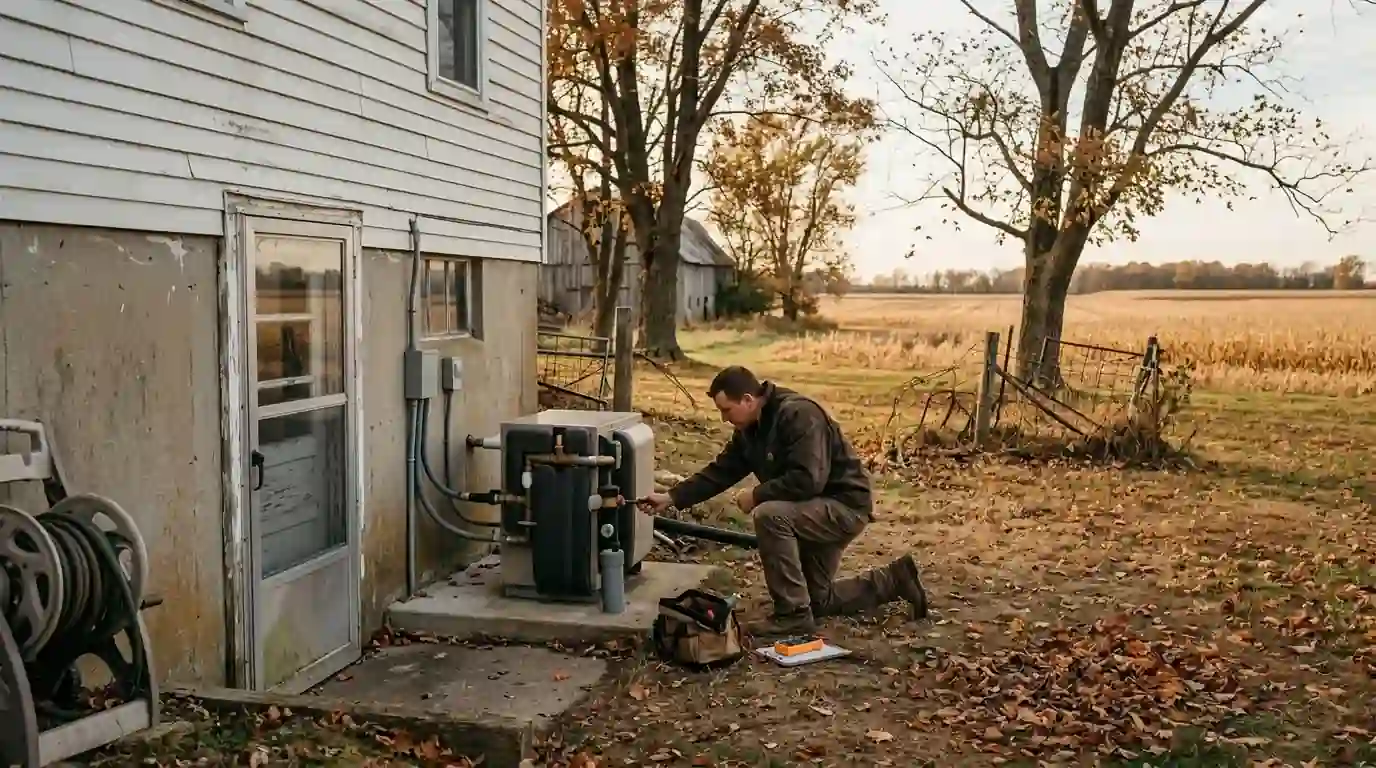
Newer subdivision homes have their own pattern. The furnace is often a builder-grade high-efficiency model in the basement, vented with PVC, paired with a condenser sized by the rule of thumb rather than a load calculation. Outside town, geothermal systems are a different animal: a water-to-air heat pump indoors, a closed loop of buried pipe outside, and a flow center pumping fluid between them. When a geothermal house gets cold, the cause is often low loop pressure or a failing flow center pump rather than the heat pump itself.
Calls we run most from Columbia City and Whitley County
Here is what typically has us heading west on US 30.
Geothermal heat pump on auxiliary heat
If the electric bill jumps and the emergency heat light is on, the heat pump has usually tripped on a pressure or flow fault. We check loop pressure, flow center pumps and entering water temperature before touching the compressor.
Propane furnace will not light
Propane units fail on the same parts as gas furnaces, plus a few of their own like regulator problems and low tank pressure. We check the supply pressure first so you are not paying for a part the furnace did not need.
Back additions that never get warm
Long trunk runs and undersized branches starve the farthest rooms. We measure airflow at the register, then look at duct size, dampers and leaks in the basement.
Aging subdivision air conditioners
Condensers in the newer neighborhoods are reaching the age where capacitors, contactors and fan motors fail in summer heat. Those repairs are usually quick when the part is on the van.
Humid summer basements
Basements near the lakes and in low ground hold moisture all summer. A ducted whole-home dehumidifier keeps the space dry without a portable unit filling a bucket.
How after-hours service works this far west
We answer 24/7 for Columbia City the same way we do for downtown addresses. The difference is preparation: the person on the phone asks whether the home burns natural gas or propane or runs a geothermal unit, so the technician brings the right gauges and parts on the first trip. On geothermal calls, tell us if the thermostat shows an error or if the outdoor emergency heat is running, because that narrows the problem quickly.
If the heat is out on a propane home, check the tank gauge before anything else. A tank under 20 percent can starve the furnace on a very cold night even when it is not empty.
Columbia City questions
Do you service geothermal heat pumps around Columbia City?
Yes, geothermal service is a regular part of our Whitley County work. We check loop pressure and flow, entering and leaving water temperatures, the flow center pumps, the refrigerant circuit and the auxiliary heat strips. Many geothermal problems come from the loop side rather than the heat pump, and a careful diagnosis keeps you from replacing equipment that is still good.
How much does AC replacement usually cost in Columbia City?
A typical central air replacement on a gas furnace home runs $3,875 to $7,945, depending on tonnage, efficiency, line set condition and whether the indoor coil is replaced too. Think of that as a typical range; the true price depends on what the visit shows. We do a load calculation first so the new unit is sized for the house rather than copied from the old label.
How quickly can Landcons get to Columbia City on a no-heat call?
Columbia City is about 20 miles from downtown Fort Wayne along US 30, which is usually a short highway drive. The actual arrival time depends on weather and calls already in progress. We answer 24/7 and give you an honest window when you call, along with a few safe checks you can make while you wait.
Is it worth switching a Columbia City area propane home to a heat pump?
Often it is worth pricing. Propane is usually more expensive per unit of heat than a modern heat pump on mild and moderate days. A dual fuel setup keeps the propane furnace for the coldest nights and lets the heat pump carry the rest. We compare your actual propane use with what a heat pump would cost to run.