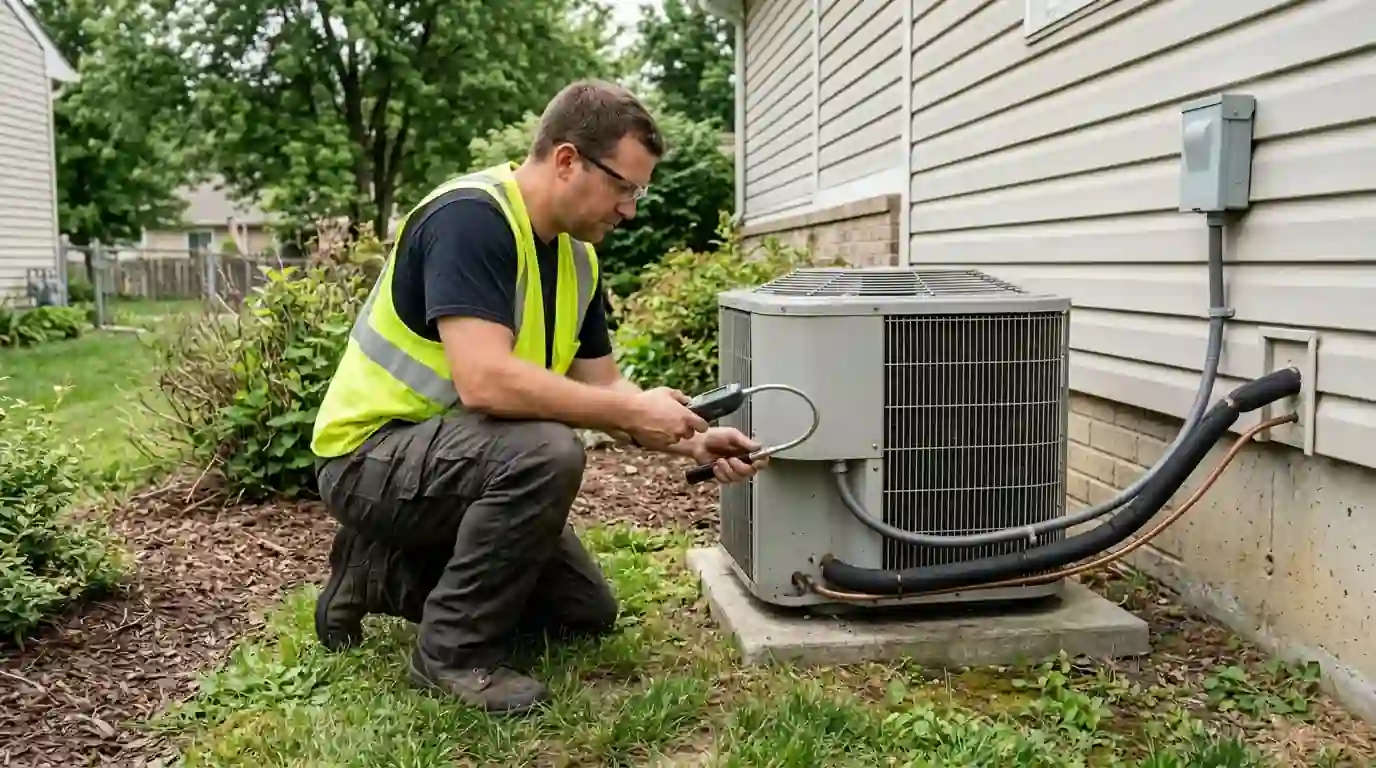
Refrigerant leak repair means locating the leak with electronic detectors, bubble solution or a nitrogen standing test, repairing or replacing the leaking part, proving the repair holds under pressure and vacuum, and then weighing in the correct charge. A leak search typically runs $245 to $495, with R-410A refrigerant at $89 to $159 per pound. Simple repairs finish in one visit.
Refrigerant does not get used up. An air conditioner or heat pump is a sealed loop, and the charge it left the factory with should last its whole life. When the level drops, it has escaped through a crack, a rubbed-through line, a corroded coil tube or a loose fitting. Adding more without finding the hole only buys time, and running low on charge in the meantime makes the compressor run hot and the coil freeze.
Landcons approaches leaks as detective work. We check the places that leak most first: Schrader valve cores, flare and brazed joints, the indoor evaporator coil, and spots where the line set rubs against the house or the condenser cabinet. When the leak is too slow to find with a detector, we recover the charge and pressurize the system with dry nitrogen, which lets us isolate the indoor coil from the outdoor unit and the line set and test each one on its own.
Signs your system is losing refrigerant
These symptoms usually build slowly over a season or two.
Needing a recharge every year
This is the clearest sign there is. A properly sealed system should never need refrigerant added after installation.
Frost on the outdoor service valve or suction line
Low charge drops coil pressure and temperature until moisture freezes on the copper. It often starts at the outdoor unit where the larger line enters.
Longer run times and a warmer house in the afternoon
As charge falls, capacity falls with it. The system keeps up in the morning but loses ground by 3 or 4 p.m.
Hissing or bubbling near the indoor coil
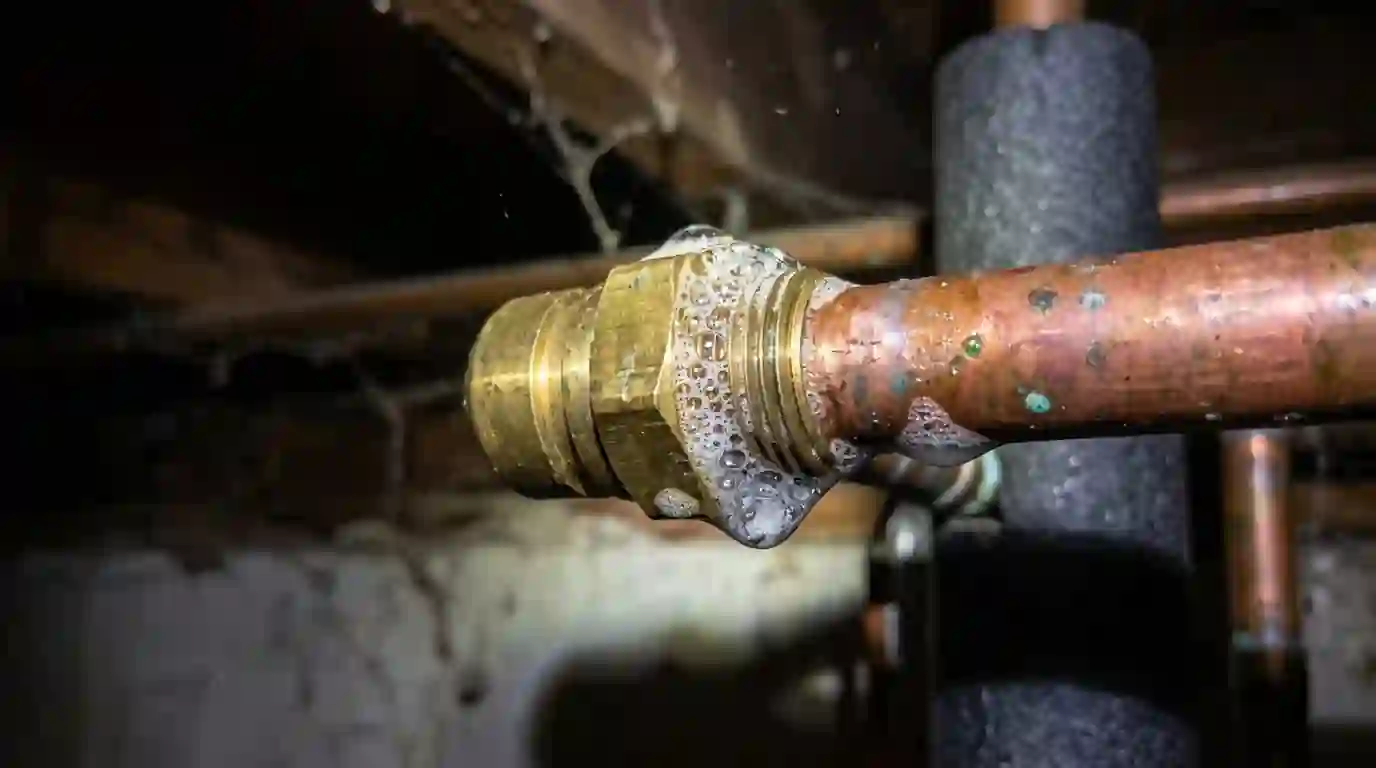
A larger leak can make a faint hiss at the coil or a gurgle in the lines. Oily stains on a fitting or coil tube are another clue.
Humidity creeping up indoors
A system short on charge removes less moisture, so the house feels damp even at a normal thermostat setting. Basements may start to smell musty in midsummer.
Electric bills rising without a hotter summer
A low charge forces the compressor to run longer for the same cooling. If usage climbs year after year with similar weather, a slow leak is a common reason.
How we track down and repair a refrigerant leak
Each step narrows the search so we fix the actual leak, not just the obvious suspect. Skipping the last two steps is how a leak repair turns into a compressor failure a year later.
Confirm low charge with superheat and subcooling
Before any leak search, we verify the system is truly undercharged and not suffering from a restriction, a bad metering device or poor airflow. Those problems can mimic a leak on the gauges.
Electronic search and bubble test
We sweep the coil, line set, service valves and fittings with a heated diode electronic detector, then confirm any hit with bubble solution. Valve cores and flare nuts are checked and tightened or replaced on the spot.
Isolate sections with a nitrogen test
If the leak hides, we recover the refrigerant as required under EPA Section 608, then pressurize with dry nitrogen. Separating the indoor coil, outdoor coil and line set lets us watch which one drops pressure.
Repair or replace the leaking part
Accessible line set and joint leaks are cut out and brazed. Leaks inside a coil's tubes are usually not repairable reliably, so we price a coil replacement instead and explain why.
Pressure test, vacuum and dehydrate
We hold nitrogen pressure to prove the repair, then pull a deep vacuum and watch it hold to confirm the system is tight and dry. Moisture left inside turns refrigerant oil acidic and damages the compressor.
Weigh in the charge and verify
Refrigerant is added by weight to the manufacturer's spec, then fine-tuned by subcooling or superheat. We note the amount on the invoice so future technicians know the baseline.
Refrigerant leak repair costs to expect
The leak search, the repair and the refrigerant are priced separately so you can see where the money goes.
| Item | Typical range |
|---|---|
| Refrigerant leak search | $245 to $495 |
| R-410A refrigerant (per pound) | $89 to $159 |
| Valve core or flare fitting repair | $145 to $345 |
| Line set leak cut out and brazed | $295 to $745 |
| Evaporator coil replacement, when the coil is leaking | $1,485 to $2,995 |
What moves the price
- How quickly the leak can be found, since a nitrogen standing test takes longer.
- Refrigerant type: R-22 costs far more than R-410A and is limited in supply.
- Total charge size, which grows with tonnage and line set length.
- Whether the leaking part is repairable or must be replaced.
- Whether the system is under a manufacturer's parts warranty that covers the coil.
These ranges are typical, not quotes. After the leak search we give you the exact repair and refrigerant cost before going further. See every range in one place in our HVAC price guide.
Where refrigerant leaks show up in Fort Wayne systems
A lot of the systems we test around Fort Wayne are R-22 units installed before about 2010 in the post-war ranches and 1970s subdivisions across Allen County. R-22 production ended in 2020, so every pound comes from recovered stock and the price reflects it. On those systems we always give you the leak repair cost alongside a replacement estimate, because pouring scarce R-22 into a leaking 20 year old coil rarely makes sense.
Indoor coils in basements are frequent leak sources here. Damp basements, especially near the rivers and around Foster Park and St. Joe, can promote corrosion on copper coil tubes, and some household chemicals stored near the furnace speed that up. Outdoors, we often find line sets where a vibrating copper pipe has rubbed against a brick edge or a cabinet corner for years. Both get worse with each humid summer, which is why a slow leak often shows itself for the first time on a sticky July afternoon. Heat pumps leak in winter too, when cold contracts the copper joints and a system that held through summer starts losing charge in January.
What helps us find your leak faster
Any history you can share shortens the search.
- How many times the system has been recharged, and roughly when.
- How much refrigerant was added, if it is on old invoices.
- The refrigerant type on the outdoor unit's data label.
- Any oily spots you have noticed on lines or fittings.
- Whether ice ever formed on the copper lines.
- Recent work near the lines, such as siding, landscaping or a deck.
- Whether the system is a heat pump that also runs in winter.
- The original installation date, from paperwork or the unit's data plate.
Brands we work on
We service Carrier, Trane, Lennox, Goodman, Rheem and every other major make, plus WaterFurnace geothermal units built here in Fort Wayne.
Areas we cover for this service
We run this work across Fort Wayne and the towns around it. These are the places we are called to most; if your town is not listed, call and ask.
Refrigerant Leak Repair questions we hear often
Why not just add refrigerant instead of paying for refrigerant leak repair?
Because the refrigerant will leak out again, usually faster each year, and you pay for it every time. Running low on charge also overheats the compressor and can freeze the coil. Finding and fixing the leak costs more once but usually less over two or three summers.
Can a refrigerant leak repair be done on an evaporator coil?
Small leaks at accessible joints or return bends sometimes can be brazed. Leaks inside the coil's tubes or caused by pinhole corrosion across the coil usually cannot be repaired reliably. In those cases we recommend replacing the evaporator coil and matching it to the outdoor unit and refrigerant.
Is refrigerant leaking into my house dangerous?
R-410A and R-22 are not toxic in the small amounts a residential leak releases, but they displace oxygen in a closed space in large amounts. Newer R-454B and R-32 are mildly flammable, which is why new indoor coils for them often include leak sensors. Any suspected large leak indoors deserves a prompt check.
Should I fix an R-22 refrigerant leak or replace the AC?
It depends on the system's age and the leak size. A minor fitting leak on a healthy system may be worth repairing. A leaking coil on a unit over 15 years old usually is not, because the repair plus R-22 can approach the cost of a new system. We price both so you can compare.
How long does refrigerant leak repair usually take?
Easy finds like valve cores or flare fittings take one to two hours including recharge. A nitrogen standing test and brazed line repair can take half a day. If a coil has to be replaced, we usually schedule a second visit once the matched coil arrives.