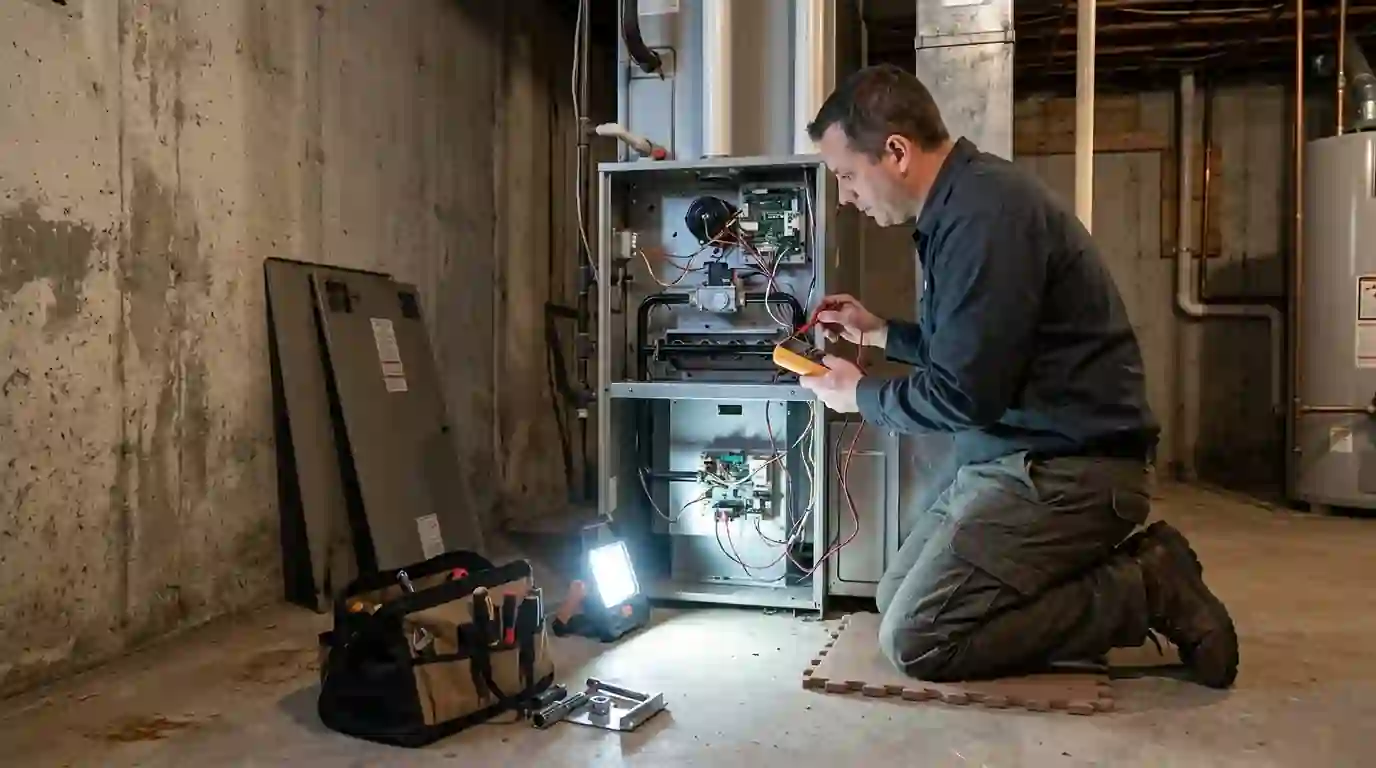
Furnace repair means finding which step of the heating sequence fails, then replacing or cleaning that part. In Allen County homes we most often find a dirty flame sensor, a cracked hot surface igniter, a stuck pressure switch or a failing inducer motor. Most repairs run $119 to $945 plus the $89 to $149 diagnostic, and many are finished on the first visit.
A gas furnace runs the same sequence every time the thermostat calls for heat: the inducer motor starts, the pressure switch proves the vent is clear, the igniter glows, the gas valve opens, the flame sensor confirms flame, and the blower pushes warm air through the ducts. When any one of those steps fails, the control board shuts the burners down and usually flashes a code. Our technician reads that code, then tests the step it points to with a meter and manometer instead of swapping parts until the heat comes back.
That approach matters because one symptom can have several causes. A furnace that lights and then shuts off after eight seconds might have a sooted flame sensor, a poor ground, or a cracked burner. A furnace that never lights could have a dead igniter, a plugged condensate trap holding the pressure switch open, or a limit switch that tripped because the filter is packed solid. Landcons techs carry the common igniters, sensors, capacitors and switches, so most no-heat calls end with the furnace running before we leave.
Furnace symptoms that mean something has failed
Some of these are a nuisance and some are a safety issue. All of them get worse with cold weather, not better.
Cool air from the registers
The blower runs but the burners never light or drop out after a few seconds. That usually points to ignition, flame sensing or a pressure switch fault rather than the blower itself.
Short cycling every few minutes
The burners light, run two or three minutes, then shut off before the house warms. An overheating heat exchanger tripping the high limit, an oversized furnace or a weak flame signal are the usual causes.
Clicking with no flame
You hear the inducer start and a click at the gas valve, but nothing lights. A cracked hot surface igniter or a failed spark module is the most common reason.
Squealing, grinding or a boom at startup
A squeal or grind from the blower compartment points to worn motor bearings. A boom when the burners light means delayed ignition from dirty burners and should be checked soon.
A blinking light on the control board
Most furnaces built after the mid-1990s have a small sight window on the lower panel where an LED blinks a fault pattern. Count the flashes and tell us when you call, because it narrows the problem before we arrive.
Far rooms that never catch up
If the furnace runs constantly but the back bedrooms stay cold, the blower may be on the wrong speed tap or the temperature rise may be out of range. A collapsed return or plugged coil can also starve airflow.
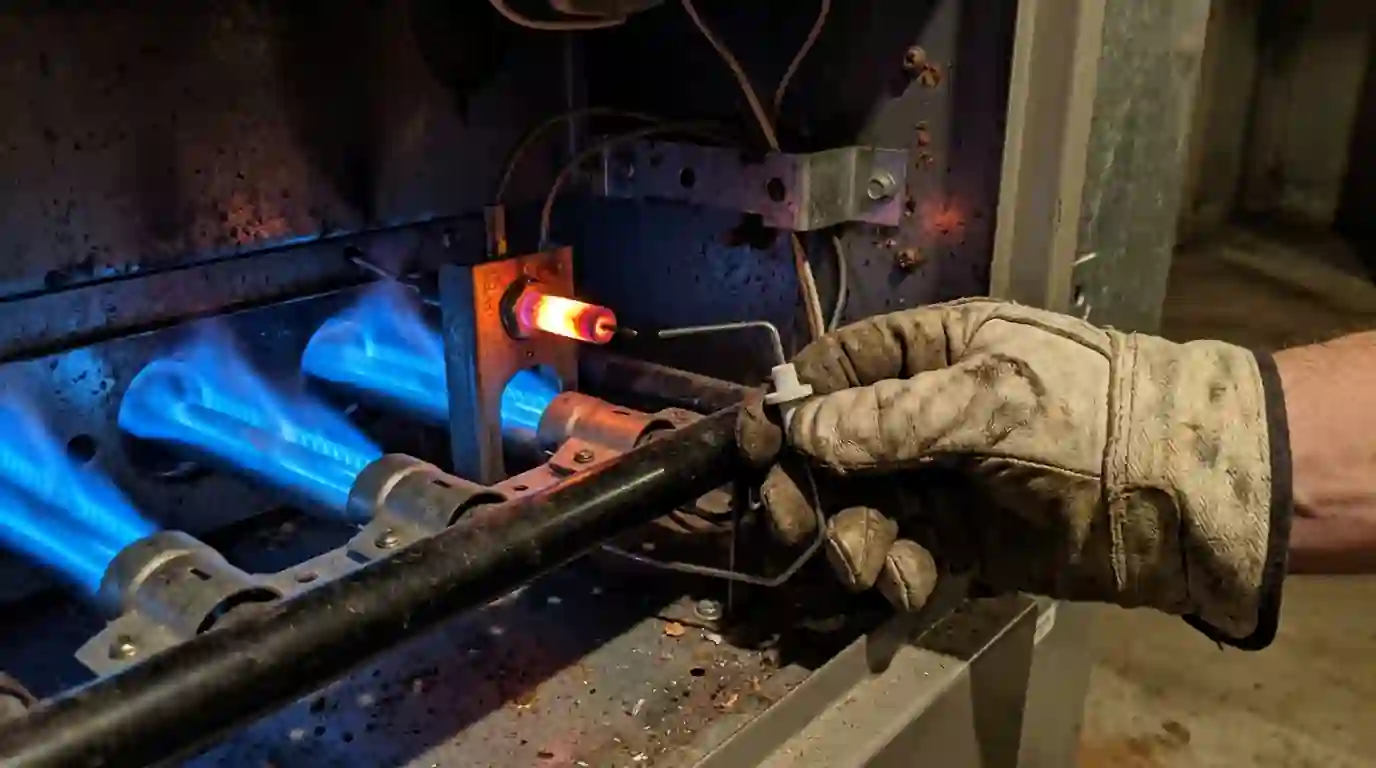
Yellow, floating burner flames
Healthy natural gas flames are mostly blue and stand firm on the burner. Yellow, lazy flames mean poor combustion and possible carbon monoxide, so shut the furnace off and call.
How we track down a furnace fault on the first visit
We test before we replace anything. It is the only way to fix the real problem instead of the symptom.
Read the code and the fault history
We pull the current fault code and, on newer boards, the last several stored faults. A history of pressure switch lockouts tells a different story than a single ignition failure.
Watch the sequence live
We call for heat at the thermostat and watch each step happen, with meter leads on the igniter, gas valve and pressure switch. Measuring is faster than guessing and keeps you from paying for parts you did not need.
Measure gas pressure and flame signal
A manometer on the gas valve confirms inlet and manifold pressure, and a microamp reading on the flame sensor shows whether flame proving is strong or marginal. Weak readings explain intermittent lockouts that never happen while a tech is standing there.
Check airflow and temperature rise
We measure supply and return temperatures and compare the rise to the range on the furnace rating plate, then take a static pressure reading. A rise out of range usually means an airflow problem that would kill the new part too.
Repair, retest and check for CO
After the repair we run the furnace through several full cycles, check carbon monoxide in the flue and in the room air, and confirm the high limit never trips. You get a plain explanation of what failed and why.
What common furnace repairs cost in the area
These are typical installed ranges for the parts we replace most. The diagnostic fee is separate and quoted before we start.
| Item | Typical range |
|---|---|
| Diagnostic visit, weekday hours | $89 to $149 |
| Flame sensor clean or replace | $119 to $235 |
| Hot surface igniter | $189 to $345 |
| Pressure switch | $185 to $365 |
| Inducer motor | $485 to $945 |
| Blower motor | $445 to $1,185 |
What moves the price
- Variable-speed ECM blower motors cost more than older PSC motors, and two-stage furnaces use different gas valves and boards than single-stage ones.
- Some manufacturers sell a part only as a kit with brackets and harnesses, which raises the price.
- Parts still covered by the manufacturer's parts warranty cost less, though labor is still charged.
- Furnaces boxed into tight closets, crawl spaces or attics take longer to work on safely.
These are typical ranges for this market, not quotes. The technician gives you an exact price after testing, before any repair begins. See every range in one place in our HVAC price guide.
Why furnaces in Allen County basements fail the way they do
Most homes around here keep the furnace in the basement next to the water heater, sump pit and laundry. That spot is handy, but damp basements near the St. Marys and St. Joseph rivers rust burner trays, corrode igniter connections and grow mineral scale in condensate traps. Dryer lint drifts into return grilles near the laundry, and a basement remodel often leaves the furnace boxed into a closet with too little combustion air. We see all of those on Fort Wayne repair calls, and we look for them on every visit because they cause repeat failures.
The weather is the other factor. With January nights averaging around 17°F, a furnace in this market runs long cycles from roughly October through April. Parts that limp along in a mild climate quit here during the first real cold snap: a flame sensor that was marginal in November locks out in January, and an inducer bearing that hummed all fall seizes on a single-digit night. In the older central neighborhoods we also find original masonry chimneys venting newer furnaces, where a cracked flue tile or a blocked chimney cap trips the pressure switch.
Quick checks before you call about a furnace that will not heat
These take a few minutes and solve a surprising number of no-heat calls.
- Confirm the thermostat is set to Heat and at least three degrees above room temperature.
- Replace thermostat batteries if the display is blank or faint.
- Make sure the furnace service switch, which looks like a light switch on or near the unit, is on.
- Look for a tripped furnace breaker and reset it once, not repeatedly.
- Pull the filter and replace it if it is gray and caked with dust.
- On a high-efficiency furnace, check that the white PVC intake and exhaust pipes outside are not blocked by snow or ice.
- Write down the blinking light pattern on the control board before you turn the power off.
Brands we work on
We service Carrier, Trane, Lennox, Goodman, Rheem and every other major make, plus WaterFurnace geothermal units built here in Fort Wayne.
Areas we cover for this service
We run this work across Fort Wayne and the towns around it. These are the places we are called to most; if your town is not listed, call and ask.
Furnace Repair questions we hear often
How long does a typical furnace repair take in Fort Wayne?
Most furnace repairs take one to two hours once the technician arrives, including testing and a full run cycle afterward. Igniters, flame sensors and pressure switches ride on the truck. Inducer and blower motors sometimes need to be ordered for a specific model, which can mean a return visit the next day, and we tell you right away if that is the case.
Is furnace repair worth it on a 20-year-old furnace?
It depends on the part and the heat exchanger. A $189 igniter on a sound 20-year-old furnace is usually worth it. A $945 inducer on a furnace with rust on the heat exchanger and no manufacturer coverage often is not. We show you what we found and give you both numbers, the repair and a replacement range, so you can decide.
Why does my furnace keep needing the flame sensor cleaned?
A flame sensor collects a thin oxide coating over time, but repeated buildup within one season usually points to something else: dusty or chemical-laden combustion air from a nearby laundry, a poor ground on the burner assembly, or incorrect gas pressure. During the repair we check the microamp reading and the root cause so the cleaning lasts.
Can furnace repair fix one room that never gets warm?
Sometimes. If the blower speed is set too low or the temperature rise is off, adjusting the furnace helps every room. If one room is cold because of a crushed or disconnected duct in the basement ceiling, the fix is ductwork rather than the furnace. Our technician checks both while on site so you are not paying for the wrong repair.
Do you handle furnace repair on converted gravity systems in older homes?
Yes. Many pre-1940 homes in West Central, Forest Park and Southwood Park have gravity systems converted to forced air, often with a newer furnace tied into large original ducts. Repairs there follow the same testing, with extra attention to chimney venting and combustion air, since those houses often still vent through a masonry chimney.