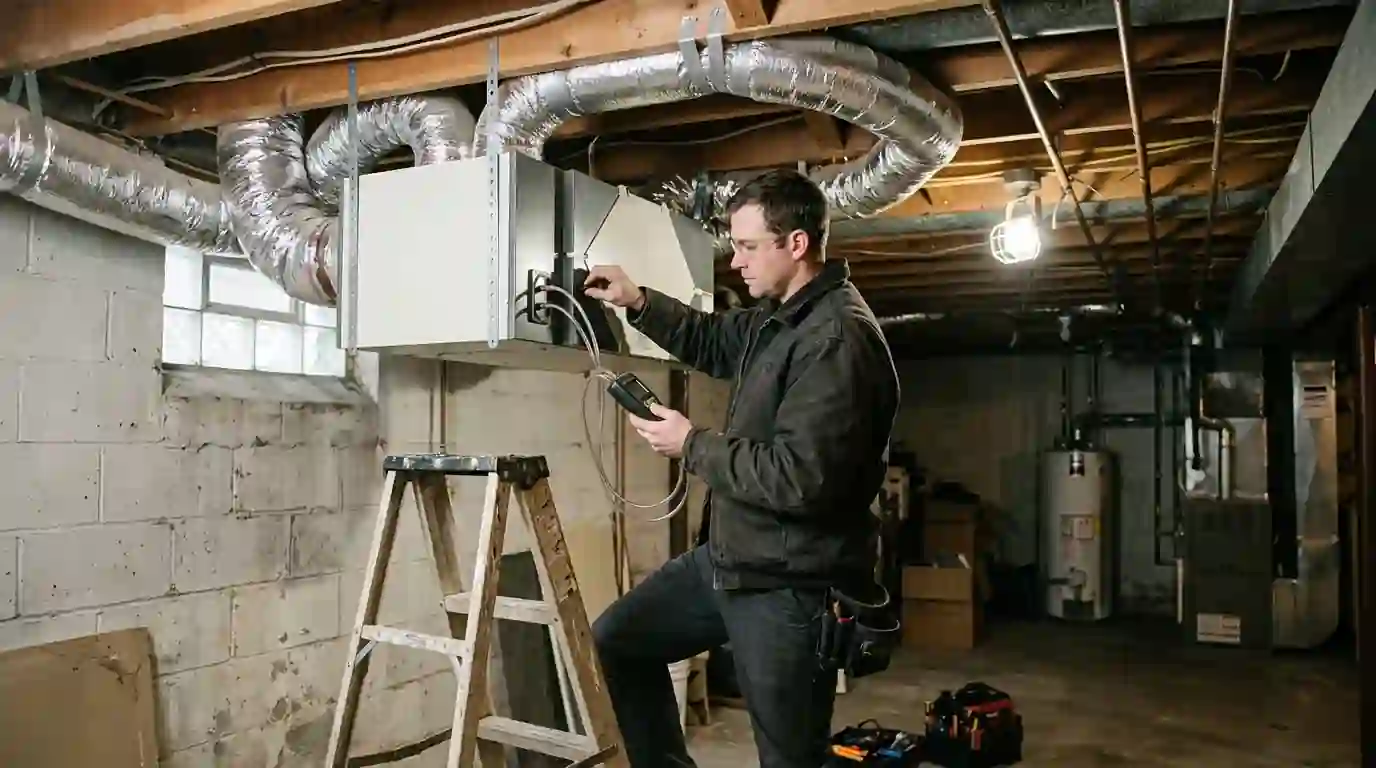
An ERV or HRV is a balanced ventilator that brings in outdoor air and exhausts stale indoor air at the same rate, passing both streams through a core that transfers heat. Most homes need 50 to 150 CFM of continuous fresh air. Installed cost typically runs $1,985 to $4,495, and most jobs take one to two days.
Builders have gotten very good at sealing houses. House wrap, spray foam, better windows and sealed attic hatches keep heat in, but they also keep moisture, cooking fumes, carbon dioxide and off-gassing from new furniture in. Older homes got fresh air whether anyone wanted it or not through gaps and cracks. A tight home needs it on purpose, in a controlled amount, without opening a window when it is 17°F outside.
A heat recovery ventilator, or HRV, moves heat from the outgoing air into the incoming air in winter and does the reverse in summer. An energy recovery ventilator, or ERV, transfers some moisture as well. Both run quietly near the furnace and tie into the duct system or have their own small duct runs. Landcons sizes the airflow to your home's square footage and bedroom count, then balances supply and exhaust so the house does not end up under negative pressure.
ERV, HRV or exhaust-only ventilation
Every option brings in fresh air, but they handle heat, moisture and pressure differently.
| Option | Best for | Keep in mind |
|---|---|---|
| ERV (energy recovery) | Most tight homes here that dry out in winter and stay humid in summer | Recovers heat and some moisture, core needs yearly cleaning |
| HRV (heat recovery) | Homes with high winter moisture from large families or hot tubs | Recovers heat but sends moisture out, which can dry a house further |
| Exhaust-only bath fan on a timer | Small or moderately tight homes on a tight budget | Puts the house under slight negative pressure and loses heat |
| Supply air duct to the return | Simple fresh air in mild cases | Unconditioned outdoor air can chill the return in January |
Does your house need mechanical ventilation?
Ventilation problems are easy to miss because the air never looks dirty. These clues point toward a home that is too tight for its own good.
Heavy condensation on windows all winter
Moisture from showers, cooking and breathing has nowhere to go in a tight house. If windows run wet even with no humidifier, the house needs more air exchange.
Odors that linger for hours or days
Fish, burnt toast and pet smells should clear in an hour or two. Lingering odors mean the air is barely changing.
Stuffy bedrooms by morning
Carbon dioxide from sleeping people builds up behind closed doors. Readings above 1,000 to 1,200 ppm often line up with headaches and grogginess.
A house built or remodeled in the last 20 years
Newer homes often test well under 3 air changes per hour at 50 pascals on a blower door. At that level, mechanical ventilation is usually the right call.
Backdrafting when exhaust fans run
A range hood or bath fan can pull a house negative and draw combustion gases back down a water heater flue. Balanced ventilation does not add to that pull.
Spray-foamed attic or finished basement project
Major air sealing can tip an older house from leaky to tight in one project. It is a good time to add fresh air.
How we size and install a balanced ventilator
The goal is the right amount of fresh air, delivered where people breathe, with the exhaust pulled from where moisture starts.
Calculate the airflow target
We use ASHRAE 62.2 guidance, which bases continuous ventilation on floor area and the number of bedrooms. A 2,400 square foot, four-bedroom home typically lands around 80 to 90 CFM.
Choose ERV or HRV
In our climate, an ERV usually wins for homes that run dry in winter and humid in summer, because it holds back some moisture each way. An HRV can suit homes with too much winter moisture.
Locate the hoods outside
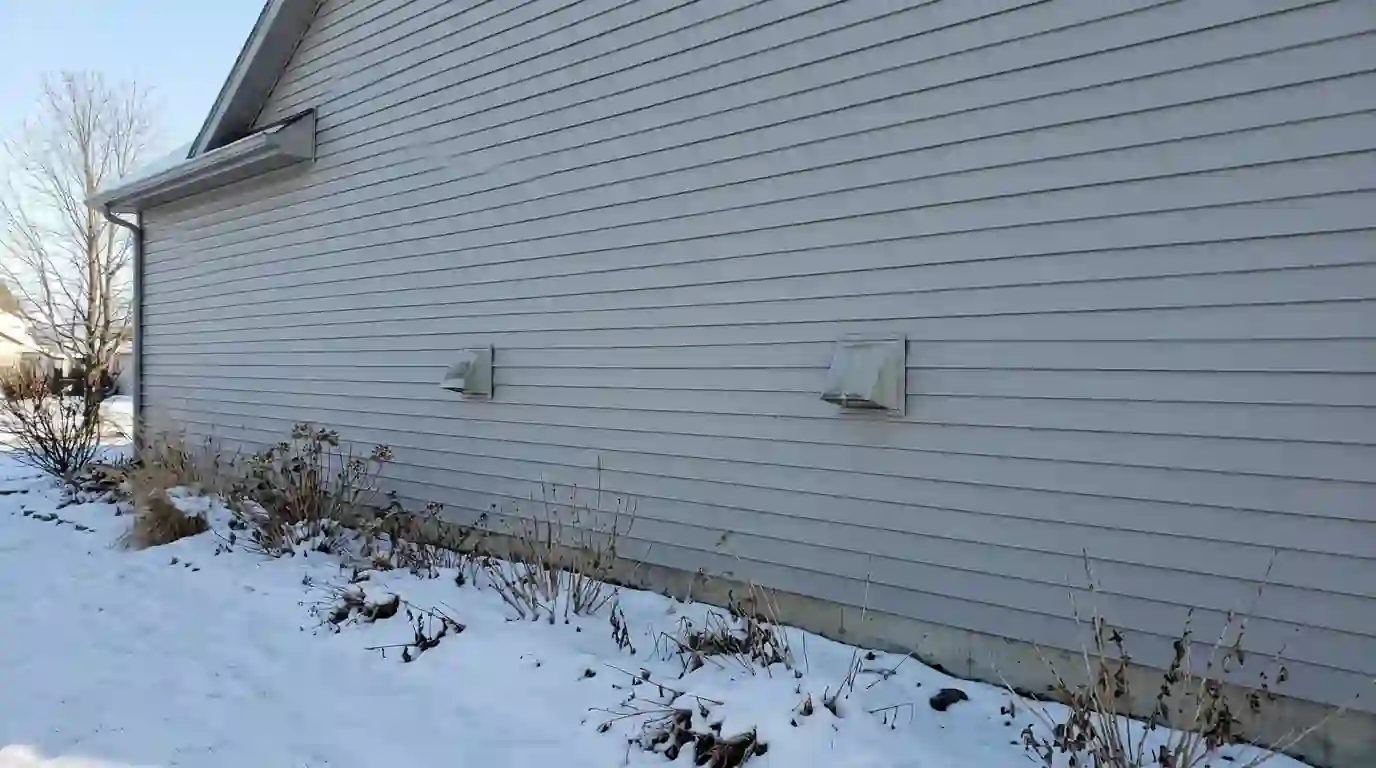
Fresh air intake and stale exhaust hoods must sit at least 10 feet apart and away from dryer vents, driveways and gas meters. We pick wall spots clear of snow drifts.
Run ducts and connect to the system
We use insulated duct for the outdoor connections to stop condensation. Exhaust pickups often go in bathrooms or the kitchen area, and fresh air goes to the furnace return or bedrooms directly.
Balance supply and exhaust
With a flow hood or the unit's balancing ports, we set intake and exhaust to within about 10 percent of each other. That keeps the house near neutral pressure.
Program the controls
We set continuous or timed operation, add boost switches in baths if you want them, and show you how to clean the core and filters.
Why tight Huntertown and Aboite homes need planned fresh air
Huntertown's subdivisions have mostly gone up since the 2000s, and much of the newer construction in Aboite and the north side is far tighter than the post-war ranches closer to downtown. That tightness saves money on heating, which matters in a market where the furnace runs from October into April. It also means that on a calm January day, almost no outdoor air gets in. Families of four or five in a tight house can push indoor humidity and carbon dioxide up fast.
Our climate swings both ways, with January nights near 17°F and July afternoons around 84°F with real humidity. That is why we lean toward ERVs for most homes in Allen County: the core helps keep winter air from getting too dry and summer air from getting too damp. Allen County is also in EPA radon zone 1, and while a ventilator is not a radon fix, test results should be in hand before you change how a house breathes.
ERV and HRV installation costs
These ranges cover equipment, ducts and balancing for typical single-family homes.
| Item | Typical range |
|---|---|
| ERV or HRV, installed and balanced | $1,985 to $4,495 |
| Dedicated bathroom exhaust pickups | $385 to $795 |
| Annual core cleaning and filter change | $89 to $159 |
| Replacement ERV core, if damaged | $385 to $895 |
What moves the price
- Tying into the furnace ducts costs less than a fully dedicated duct system.
- Finished basement ceilings make duct routing slower and add patch work.
- Larger homes with more bedrooms need higher-CFM units.
- Two exterior wall penetrations are standard, while brick or stone siding adds labor.
These are typical ranges for this area. We confirm the price after reviewing your floor plan, duct layout and wall construction. See every range in one place in our HVAC price guide.
Living with an ERV or HRV
Ventilators are low-maintenance, but they are not no-maintenance.
- Vacuum or wash the filters every two to three months.
- Clean the core once a year following the manual.
- Clear snow and leaves away from the outdoor hoods.
- Run the unit continuously at its low setting rather than switching it off.
- Use boost mode during showers, parties and heavy cooking.
- Call us if one hood stops moving air, which usually means a frozen core or loose duct.
- Test for radon before and after major ventilation changes.
Brands we work on
We service Carrier, Trane, Lennox, Goodman, Rheem and every other major make, plus WaterFurnace geothermal units built here in Fort Wayne.
Areas we cover for this service
We run this work across Fort Wayne and the towns around it. These are the places we are called to most; if your town is not listed, call and ask.
ERV & HRV Ventilation questions we hear often
Should I choose an ERV or HRV for a Fort Wayne home?
For most homes here, an ERV. It recovers heat like an HRV but also keeps some moisture where it belongs, helping winter air stay less dry and summer air less humid. An HRV makes sense if your house has too much winter moisture, such as a large household, an indoor pool or a hot tub. We look at your humidity readings before recommending one.
Does an ERV raise my heating bill?
It adds some load, since you are bringing in cold air on purpose. The core recovers a large share of the heat from the outgoing air, so the incoming air arrives much warmer than outdoor temperature. The fan motor uses about as much power as a couple of light bulbs. Many owners find the cost modest compared to the improvement in air quality.
Can an HRV freeze up in a northeast Indiana winter?
It can on very cold nights. Moisture in the exhaust air condenses and can freeze in the core when outdoor air drops into the single digits. Quality units have a defrost cycle that briefly recirculates or stops intake air to clear it. We confirm the defrost setting during setup so the core stays clear through January.
Will an ERV ventilation system remove radon from my house?
It can lower radon somewhat by diluting indoor air, but it is not a radon mitigation system. Allen County is in EPA radon zone 1, so every home should be tested. If results are at or above the EPA action level of 4 pCi/L, a dedicated sub-slab mitigation system is the proper fix, installed by a radon specialist.
How noisy is an ERV running all the time?
A properly installed unit on low speed is usually quieter than a refrigerator. It sits near the furnace on hangers or a shelf with vibration isolation, and insulated ducts keep air noise down. The outdoor hoods are silent from inside. If you hear the unit from living spaces, the ducts or mounting need adjustment.