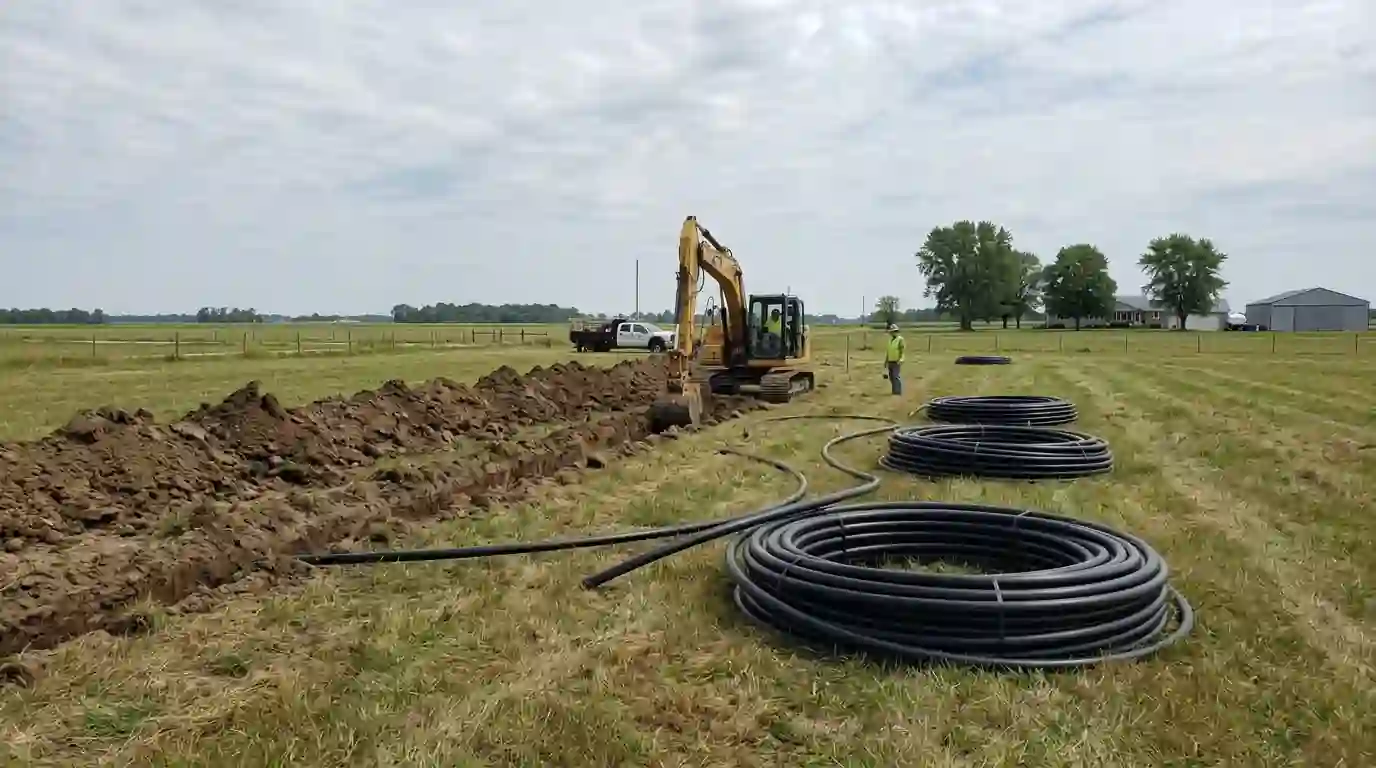
A geothermal heat pump moves heat between your home and the ground through buried fluid loops, giving very efficient heating and cooling. A complete system with loop typically runs $21,485 to $39,895 installed here. Service visits run $139 to $289 and usually find low loop pressure, a weak flow center pump, scaled heat exchangers or airflow problems rather than ground loop failures.
Ground temperature a few feet down in northeast Indiana stays in the low to mid 50s year-round, warmer than January air and cooler than July air. A geothermal heat pump circulates a water and antifreeze mix through high-density polyethylene pipe buried in that ground, then uses a refrigerant circuit inside the house to concentrate the heat it picks up. Because the source temperature is steady, the system does not need a defrost cycle and does not lose capacity on cold nights the way an air-source heat pump does. Efficiency ratings, measured as COP and EER, are well above what any furnace or air-source unit can match.
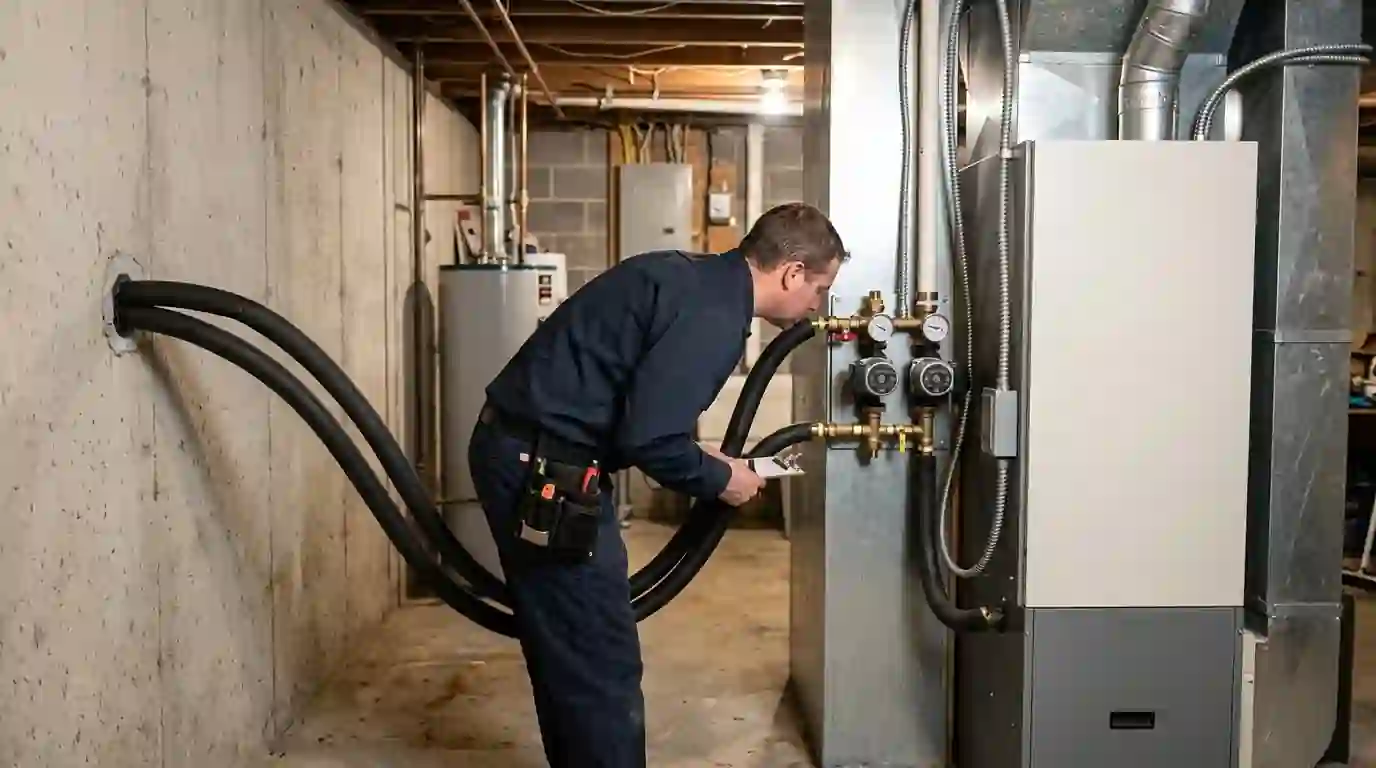
Most of the system lives indoors: a cabinet in the basement that looks a bit like a furnace, a flow center with one or two circulating pumps, and the ductwork. The ground loop itself, once installed, typically lasts for decades. That means most geothermal service is about the indoor unit and the loop fluid, not digging. Landcons handles both new systems and service on existing ones, including older units that were installed before the current owner bought the house and came with no paperwork.
Comparing geothermal loop types
The loop choice depends mostly on your land, budget and water access.
| Option | Best for | Keep in mind |
|---|---|---|
| Horizontal closed loop | Rural lots with open land | Needs large excavation area; yard regrows over a season |
| Vertical closed loop | Smaller lots or new subdivisions | Drilling costs more; minimal yard space used |
| Pond or lake loop | Properties on suitable water | Needs enough depth and volume; check local rules |
| Open loop (well water) | Homes with strong wells and good water quality | Water chemistry and discharge rules matter; more maintenance |
Is geothermal a good match for your property?
Geothermal makes the strongest case in a few specific situations. These are the ones we see most around the region.
You have land, or a site for vertical bores
Horizontal loops need a large open area dug to about six feet. On smaller lots, vertical bores drilled a few hundred feet deep take far less yard space but cost more.
You heat with propane or electric resistance
Rural homes without natural gas often pay the most to heat. Geothermal brings heating cost down sharply compared with propane or baseboard heat.
You plan to stay in the home long term
The upfront cost is high and the payback comes from years of lower bills. Owners planning to stay ten years or more see the most benefit.
You are building new or replacing everything
Adding the loop during new construction or a full system replacement avoids paying twice for excavation and equipment.
Your existing geothermal unit is 20 or more years old
The loop is often still good when the indoor unit wears out. Replacing only the heat pump cabinet costs far less than a full new system.
How we install and service geothermal systems
New installs and service calls share the same goal: a tight loop, good flow and a heat pump running in its rated range.
Load calculation and loop design
We size the heat pump to the home's heating load, then size the loop for that unit, based on soil type, available land and whether horizontal, vertical or pond loops fit the property. An undersized loop is the most common cause of poor geothermal performance.
Loop installation and pressure testing
Loop pipe is heat-fused at every joint and pressure tested before backfill. The loop is then flushed and purged of air with a high-volume pump and filled with the correct antifreeze mix.
Flow center and indoor unit
We set the geothermal cabinet in the basement, connect the flow center, ductwork, condensate drain and, if requested, a desuperheater that preheats domestic hot water.
Startup readings
We record entering and leaving water temperatures, loop pressure drop, flow in gallons per minute, and supply and return air temperatures. Those readings become the baseline for every future service visit.
Service visits on existing systems
On a service call we compare current readings to the design or last recorded numbers, check loop pressure and antifreeze strength, test the flow center pumps, and inspect the water-to-refrigerant heat exchanger for scaling.
Airflow and controls check
Many geothermal complaints are actually airflow problems: dirty filters, closed registers or a failing blower. We check static pressure and blower operation on every visit.
Clear notes for the next owner
We leave you a written record of loop type, readings and fluid mix. Geothermal homes change hands often without that information, and it saves time later.
Why geothermal is common around northeast Indiana
Geothermal has deep roots here. WaterFurnace, one of the major geothermal heat pump manufacturers, is headquartered in Fort Wayne, and ground-source systems have been installed across the region for decades. You are more likely to find them on rural lots in Whitley, DeKalb, Noble and Adams counties than in city neighborhoods, largely because those properties have room for horizontal loops and often lack natural gas. Many of those homes were heated with propane before switching, and owners there tend to be the strongest fans of the technology. It also means plenty of older ground-source units are still running across the area and due for service.
The local climate plays to geothermal's strengths. With January nights near 17°F and humid July afternoons in the mid 80s, a system that pulls steady 50-something degree heat from the ground avoids the defrost cycles and lost capacity air-source units face. Soil across much of Allen County and the surrounding farmland is suited to horizontal trenching, while lake properties in Noble and Steuben counties sometimes use pond loops where lake depth and regulations allow. Rebates from Indiana Michigan Power change from year to year, and we will tell you what is current.
Geothermal heat pump costs, from service visit to full system
The loop drives most of the upfront cost. Replacing only the indoor unit on a sound loop is much less.
| Item | Typical range |
|---|---|
| Geothermal service visit with loop readings | $139 to $289 |
| Complete geothermal system with new loop | $21,485 to $39,895 |
| Whole-house ductwork, if the home has none | $4,485 to $11,995 |
| Smart thermostat with staging setup | $189 to $549 |
What moves the price
- Vertical bore loops cost more than horizontal trenches but suit smaller lots.
- Soil type, rock and groundwater conditions affect drilling and trenching cost.
- Two-stage or variable-speed geothermal units cost more but run quieter and more efficiently.
- A desuperheater for domestic hot water adds cost but cuts water heating bills.
- Reusing an existing, tested loop with a new indoor unit can save a large share of the system cost.
These are typical ranges for the area. A site visit and load calculation set the real price, especially for loop design. See every range in one place in our HVAC price guide.
Questions to ask about a geothermal system
Whether you are buying a home with geothermal or adding one, these answers matter.
- What type of loop is it: horizontal, vertical, pond or open well?
- What antifreeze is in the loop, and what concentration?
- What were the startup entering water temperatures and flow rate?
- Is the flow center a pressurized or non-pressurized type?
- Does the system include a desuperheater tied to the water heater?
- Is there a backup electric heat strip, and how much?
- When was the loop last pressure checked and topped off?
- Are there records of the loop layout for future digging?
- Is the heat pump single-stage, two-stage or variable-speed?
Brands we work on
We service Carrier, Trane, Lennox, Goodman, Rheem and every other major make, plus WaterFurnace geothermal units built here in Fort Wayne.
Areas we cover for this service
We run this work across Fort Wayne and the towns around it. These are the places we are called to most; if your town is not listed, call and ask.
Geothermal Heat Pumps questions we hear often
How long do geothermal heat pumps and loops last?
The indoor geothermal heat pump typically lasts 20 to 25 years because it sits indoors away from weather. The buried polyethylene loop often lasts much longer, commonly rated for 50 years or more. When the indoor unit wears out, most owners keep the loop and replace only the cabinet, which keeps the second round much cheaper than the first.
Why is my geothermal heat pump suddenly using backup heat?
Common causes include low loop pressure from a slow leak or air in the loop, a failed flow center pump, antifreeze too weak for the entering water temperature, or a scaled heat exchanger. Dirty filters and blower problems also trigger backup heat. A geothermal service visit with loop readings usually pinpoints which one.
Do geothermal heat pumps work in Fort Wayne winters without a furnace?
Yes. Because the ground stays in the 50s year-round, a properly sized geothermal system heats the home through the coldest January nights without a furnace. Most include a small electric heat strip for rare extremes or emergencies. Undersized loops are the main reason some systems struggle in deep cold.
Can you service geothermal heat pumps from any manufacturer?
Yes. We service geothermal systems from all the common makers, including units installed long before the current owner moved in. If there are no records, our first visit includes documenting the loop type, flow and temperature readings so future service is faster and more accurate.
Does a geothermal system also provide hot water?
Many do, through an optional desuperheater that captures extra heat from the refrigerant circuit and sends it to the water heater tank. It works best in summer cooling mode, when that heat would otherwise go into the ground, and it helps in winter as well. It does not fully replace a water heater.