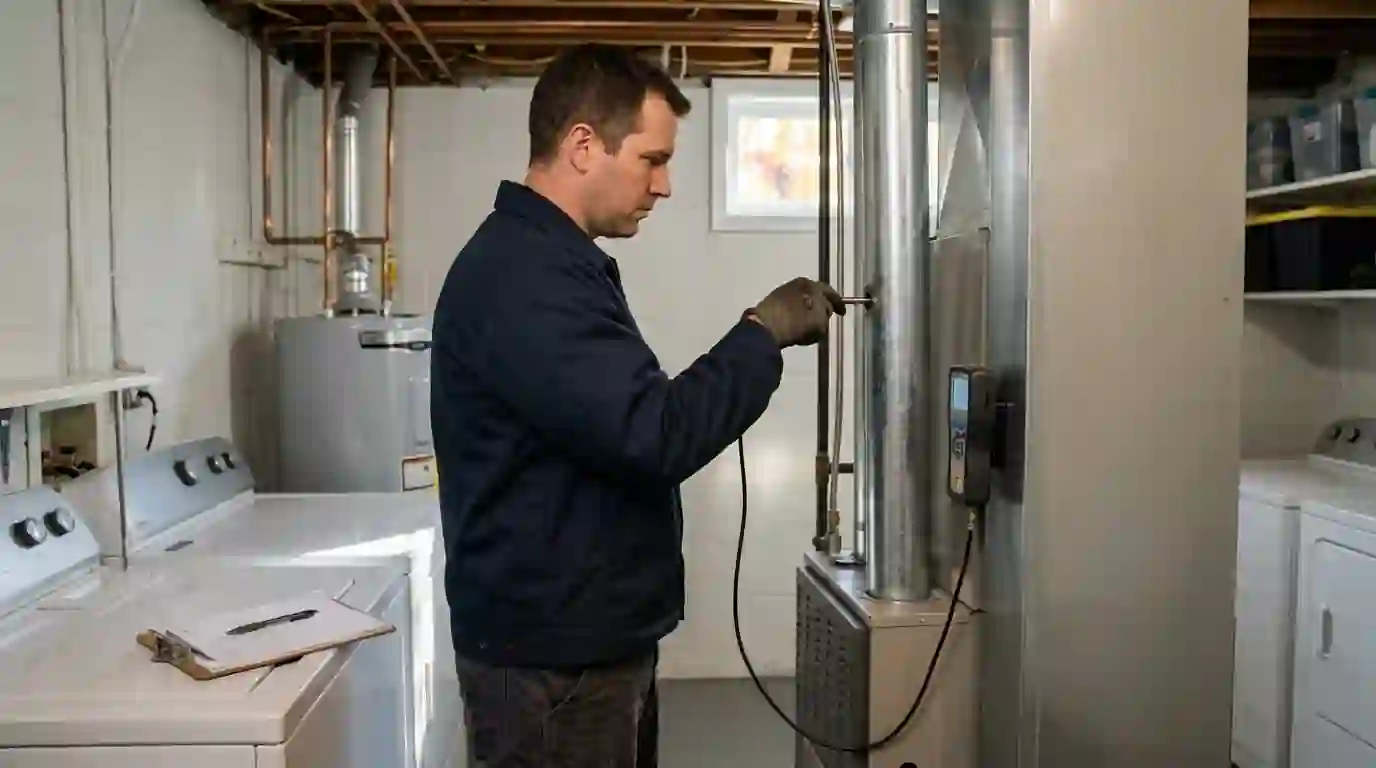
A furnace tune-up is a measured safety and efficiency check: cleaning the burners and flame sensor, inspecting the heat exchanger, testing for carbon monoxide, and taking gas pressure, temperature rise and static pressure readings. It usually takes 60 to 90 minutes and runs $89 to $159. Most problems we find are small parts that would have failed in January.
Most furnace breakdowns in this area happen on the first cold weekend or the coldest week of January, when the system runs nearly nonstop and every service company is busy. A tune-up moves that discovery to September or October, when parts are easy to get and you can choose a convenient time. It is also the visit where we look for safety problems that do not cause a no-heat call at all, like a hairline crack in the heat exchanger or a vent pipe that has separated behind the furnace.
A good tune-up is a set of readings, not a quick vacuum and a sticker. We record the flame sensor microamps, manifold gas pressure, temperature rise, total external static pressure, inducer amp draw and carbon monoxide in the flue. Those numbers tell us how the furnace is aging. When we come back next year we can compare, and a reading trending the wrong way, such as a blower drawing more amps each fall, lets you plan a repair instead of getting surprised by it.
What you can do between furnace tune-ups
A few minutes a month keeps the furnace healthier between professional visits.
- Check the filter monthly in heating season and change it when it looks gray.
- Keep at least two to three feet clear around the furnace and water heater.
- Do not store paint, gasoline or cleaning chemicals near the furnace.
- Keep supply registers and return grilles open and unblocked by furniture.
- Clear snow and drifting leaves from the outdoor PVC vent pipes on high-efficiency furnaces.
- Test carbon monoxide alarms each month and replace them by the date on the back.
- Pour a cup of water into the condensate trap floor drain if it smells like sewer gas.
- Write down any new noises or error light patterns so you can tell the technician.
When a furnace tune-up is overdue
Once a year in the fall is the right rhythm for most homes. These situations make it more urgent.
No service in two or more years
Flame sensors oxidize, burners collect rust flakes and condensate traps scale up over two heating seasons. The furnace may still run, but it is closer to a lockout than you think.
The first startup smells stronger than dust
A brief burning-dust smell on the first cold morning is normal. A smell that lingers, or anything like exhaust or chemicals, needs a check before you rely on the furnace.
You moved into a house with unknown history
If the previous owners left no records, a tune-up gives you a baseline on the furnace's condition, venting and safety before winter.
The manufacturer warranty asks for yearly maintenance
Many furnace manufacturers expect annual professional service to keep parts coverage in good standing. A dated record with readings is useful if you ever file a claim.
Pets, remodeling dust or a nearby laundry
Hair, drywall dust and lint clog filters and blower wheels far faster than ordinary household dust. Those homes benefit from a closer look each fall.
Higher gas use last winter
If NIPSCO bills jumped on the same thermostat settings, a dirty blower wheel, low gas pressure or a clogged coil may be lowering output.
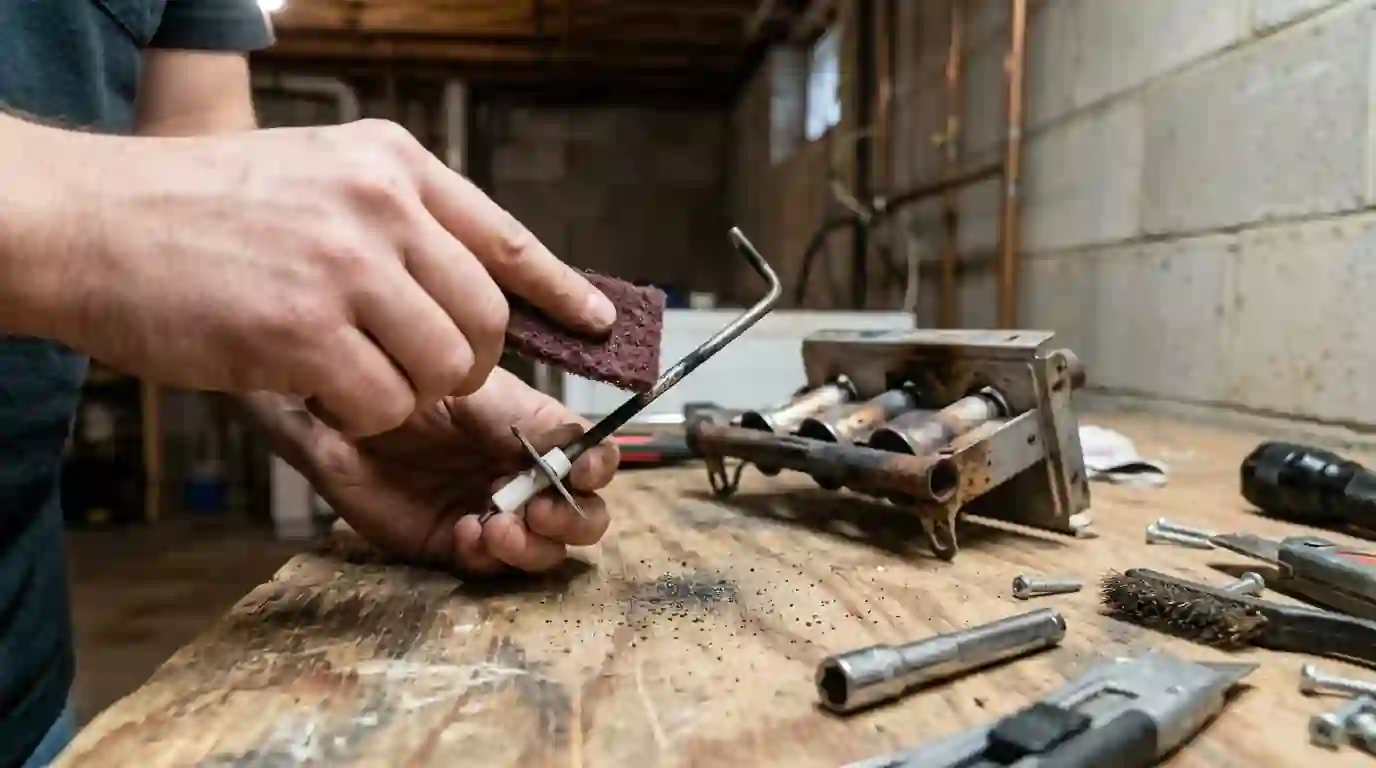
What we check and measure on every furnace tune-up
Every visit follows the same order so nothing is skipped, and you get the readings afterward.
Thermostat and startup sequence
We call for heat and watch the full sequence: inducer, pressure switch, ignition, flame proving and blower delay. Hesitation at any step gets noted and tested.
Burners, flame sensor and igniter
We pull and clean the flame sensor, inspect the hot surface igniter for hairline cracks, and check the burners for rust and alignment. Flame signal is measured in microamps before and after.
Heat exchanger and venting
We inspect the heat exchanger with a light and, where accessible, a camera, then follow the flue or PVC vent from the furnace to the outdoor termination. Loose joints, poor slope and corroded connectors get flagged.
Gas pressure and combustion
A manometer confirms manifold gas pressure matches the rating plate, and a combustion analyzer reads carbon monoxide in the flue. We also check the room air near the furnace for CO.
Airflow, blower and filter
We measure temperature rise and static pressure, inspect the blower wheel for buildup, check motor amps and capacitor, and replace or advise on the filter.
Condensate system on high-efficiency units
We flush the condensate trap and hoses, test the condensate pump if there is one, and confirm the drain line is not frozen-prone. A plugged trap is one of the most common causes of midwinter lockouts.
Safeties and a written summary
We test the high limit, rollout switches and pressure switch operation, then give you the readings and anything that needs attention, ranked by urgency.
Furnace tune-up pricing and common add-on repairs
The tune-up itself is a set price. If we find a part that is failing, we quote it before doing anything.
| Item | Typical range |
|---|---|
| Furnace tune-up | $89 to $159 |
| Maintenance plan, furnace and AC visits | $15 to $29 per month |
| Flame sensor replacement found during tune-up | $119 to $235 |
| Carbon monoxide and combustion test, standalone | $89 to $169 |
What moves the price
- Furnaces that have not been serviced in years may need extra cleaning time on the blower wheel and burners.
- High-efficiency furnaces have a condensate system and a secondary heat exchanger that take longer to check.
- Units in attics or tight crawl spaces take more time to access safely.
- A maintenance plan bundles fall and spring visits and usually lowers the per-visit cost.
- Replacement filters, especially 4 to 5 inch media filters, are priced separately.
These are typical ranges for the area. The tune-up price is confirmed when you call, and any repair is quoted on site before work starts. See every range in one place in our HVAC price guide.
Why fall maintenance matters more in an Allen County heating season
A furnace here might run 1,500 or more hours between October and April, far more than one in a mild climate. That workload is why small wear items fail on schedule in the coldest weeks. Booking the tune-up in September or early October puts you ahead of the first frost and ahead of the rush, when wait times for repairs stretch out. If you live in an older central neighborhood where the furnace still vents into a brick chimney, the fall visit is also a good time to confirm the chimney cap is intact and the flue is clear of fallen mortar or bird nests.
Damp basements are the other local reason. Homes near the rivers, and many older houses across the city, have basements that stay humid all summer. That moisture rusts burner trays, corrodes igniter and flame sensor terminals, and grows sludge in condensate traps while the furnace sits idle. A summer of humidity can turn a healthy furnace into a hesitant one by October. A dehumidifier in the basement slows that damage, but it does not replace a cleaning. If you also run a central AC, ask about pairing this visit with an AC tune-up in spring, or a maintenance plan that covers both.
Brands we work on
We service Carrier, Trane, Lennox, Goodman, Rheem and every other major make, plus WaterFurnace geothermal units built here in Fort Wayne.
Areas we cover for this service
We run this work across Fort Wayne and the towns around it. These are the places we are called to most; if your town is not listed, call and ask.
Furnace Tune-Up questions we hear often
What month is best for a furnace tune-up in Fort Wayne?
September and early October work best. The furnace has not started its heavy season yet, parts are easy to get, and appointment times are flexible. A tune-up in November still helps, but by then many systems are already running long cycles and any problems found are more likely to need a quick turnaround.
Does a furnace tune-up include a carbon monoxide test?
Yes. Every furnace tune-up we do includes a combustion analysis in the flue and a carbon monoxide check of the room air near the furnace. If the flue reading is high, we clean and adjust the burners, check gas pressure and look for venting problems, then retest before we leave.
How is a furnace tune-up different from a furnace repair visit?
A furnace tune-up is preventive. We clean, measure and inspect a furnace that is still running, so problems show up early. A repair visit starts with a specific failure, such as no heat, and focuses on finding that fault. Tune-ups often prevent the repair visit, and the readings make any later repair faster to diagnose.
Can I skip a furnace tune-up on a brand-new furnace?
We still recommend one each fall, even in the first few years. New furnaces can have loose vent joints, condensate traps that collect installation debris, and gas pressure that was never fine-tuned. Many manufacturers also expect yearly maintenance to keep parts coverage intact. The first tune-up sets the baseline readings we compare against later.
Is a furnace tune-up worth it on a boiler-heated home?
A boiler needs its own annual service, which covers burners, the circulator pump, expansion tank, pressure relief valve and water chemistry. It is a different checklist than a furnace tune-up. If your home has both a boiler for radiators and a furnace for an addition, we service both on one visit.