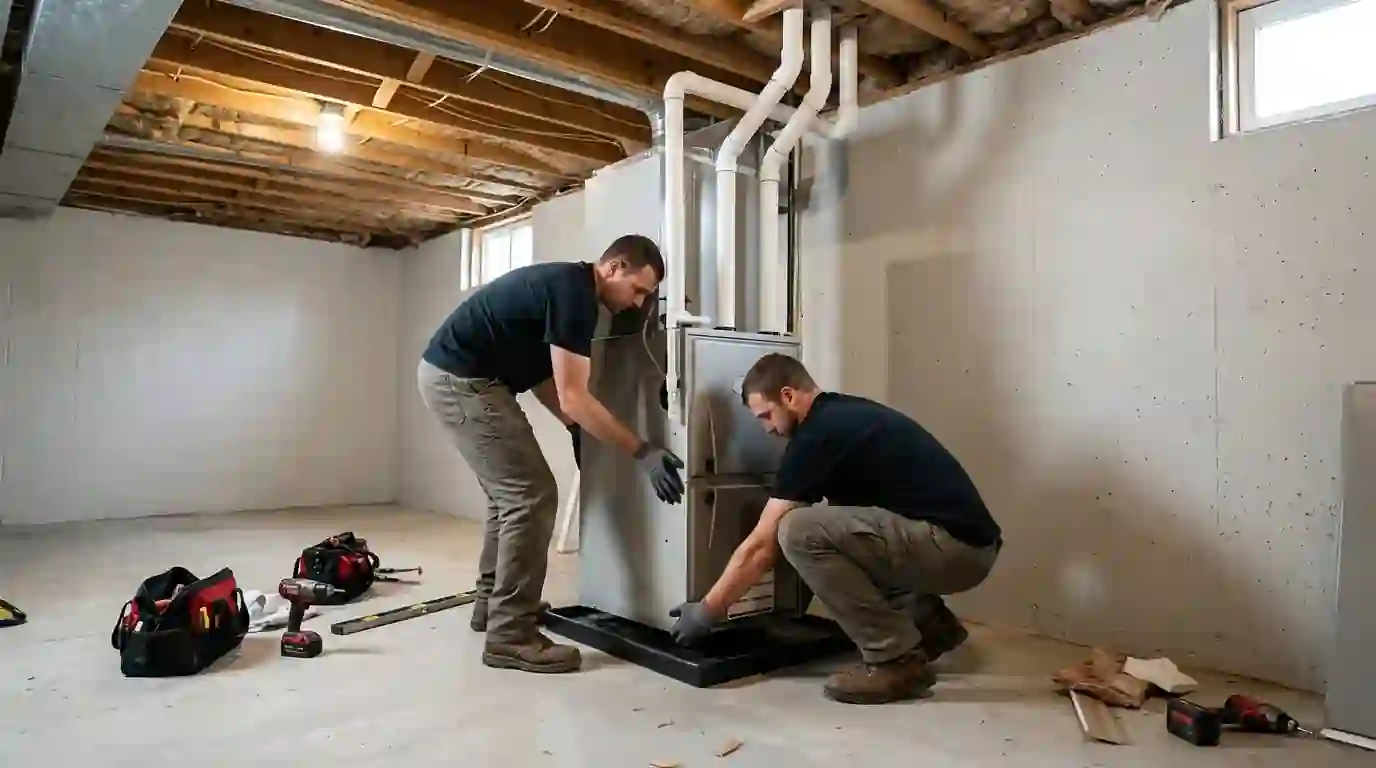
Furnace installation is removing the old unit and setting a new one sized by a load calculation, then connecting gas, venting, ductwork, condensate and controls. Typical installed prices in this area run $3,285 to $5,495 for an 80% AFUE furnace and $4,385 to $8,945 for a 95% or higher model. Most replacements take one day, with venting changes added when needed.
A new furnace is only as good as the work around it. The cabinet itself is maybe half the job. The rest is the transition to the existing plenum, the return drop, the gas piping and drip leg, the flue or PVC vent run, the condensate drain, and the thermostat wiring. A well-chosen furnace connected to a choked return or a leaky plenum will run loud, short cycle and wear out early. That is why Landcons quotes replacements after looking at the whole system, not just reading the model number off the old unit.
We start with how much heat the house actually loses on a design night. Plenty of homes in this area have furnaces two sizes too large because a previous installer matched the old unit, and the old unit was oversized for a house that has since gained new windows and attic insulation. An oversized furnace heats in short bursts, leaves cold corners and stresses the heat exchanger. A properly sized two-stage or modulating furnace runs longer, quieter cycles and keeps temperatures even from the basement to the upstairs bedrooms.
Comparing furnace efficiency and staging options
Here is how the main furnace types stack up for a typical home in the region.
| Option | Best for | Keep in mind |
|---|---|---|
| 80% AFUE single-stage | Homes with a sound chimney liner and tight budgets | Wastes about a fifth of the gas; short, noisy cycles |
| 95% to 96% AFUE two-stage | Most Allen County homes heated mainly by gas | Needs PVC venting and a condensate drain |
| 97%+ modulating with variable-speed blower | Larger homes, finished basements, comfort-focused owners | Highest price; needs well-sized ducts to deliver its benefit |
| Furnace plus heat pump (dual fuel) | Owners who also want efficient cooling and mild-weather heat | Higher upfront cost; ask about I&M rebate programs |
Signs it is time to replace your furnace rather than repair it
Age alone is not the deciding factor. These are the conditions that usually tip the decision.
A cracked or rusted-through heat exchanger
A breach in the heat exchanger can let combustion gases mix with house air. On most furnaces past the manufacturer's coverage, replacing the exchanger costs close to a new unit.
Repair bills climbing each winter
One $485 repair is normal maintenance on an aging furnace. Two or three major parts in two seasons usually means the next one is coming too.
A furnace older than about 18 to 20 years
Many furnaces in this climate reach that age with heavy use. Parts get harder to source, and efficiency is well below what a new unit offers.
Uneven heat and dry, dusty air
Single-stage furnaces blast hot air in short bursts. If some rooms swing several degrees and the air feels parched, a two-stage or variable-speed unit often fixes what repairs never did.
Gas bills rising without a rate change
When NIPSCO usage climbs year over year on the same thermostat habits, the furnace is losing efficiency. Older 60% to 70% AFUE units waste a third of the gas you buy.
What happens on furnace installation day
A standard replacement is a one-day job for a two-person crew. Here is the order we work in.
Load calculation and equipment selection
Before the install, we measure the home, note windows, insulation and orientation, and run a Manual J heat loss calculation. That number, plus a static pressure test on your ducts, decides the size and blower type.
Protect the house and remove the old unit
We lay drop cloths on the path to the basement, shut off gas and power, and disconnect the old furnace. Old equipment leaves with us.
Set, level and transition the new furnace
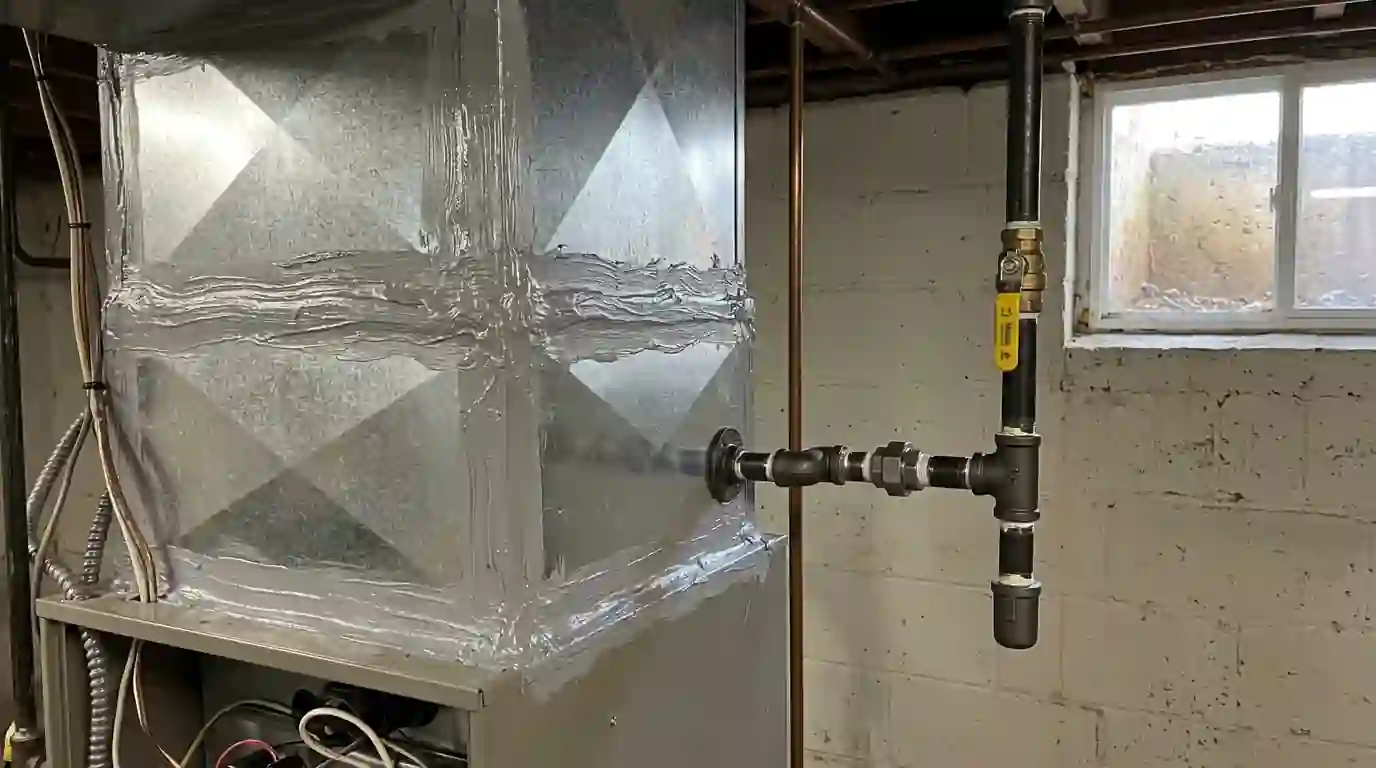
The new furnace goes on a level base, and we fabricate new sheet metal transitions to the supply plenum and return drop. Every seam is sealed with mastic or foil tape so the blower is not pulling basement air.
Gas, venting and condensate
We connect the gas line with a new shutoff and sediment trap, then run the venting the furnace requires. A 95% furnace gets PVC intake and exhaust piped outside with proper slope, and its condensate goes to a floor drain or a condensate pump.
Wiring and thermostat setup
We land the thermostat and accessory wiring, including humidifier and air cleaner connections. Two-stage and variable-speed furnaces are configured for the thermostat you have or a new one.
Startup, combustion test and walkthrough
We clock the gas meter to verify firing rate, set manifold pressure, measure temperature rise and static pressure, and run a combustion analysis for CO. Then we show you the filter, the shutoff and how to read the status light.
Choosing a furnace for northeast Indiana winters and older chimneys
Heating carries most of the load in this market. With January nights near 17°F and a season that runs from October into April, a high-efficiency furnace pays back faster here than in southern states. A 96% AFUE furnace turns almost all of its gas into heat, compared with roughly 80% for a mid-efficiency model. For a typical Allen County home that difference shows up on every NIPSCO bill. We will also tell you whether NIPSCO has a current rebate program for high-efficiency furnaces, since those programs change year to year.
Venting is the local wrinkle. In older parts of the city, such as North Anthony and the historic districts, many furnaces still vent into a masonry chimney shared with a water heater. Removing an 80% furnace from that chimney can leave the water heater orphaned in a flue that is now too large, which causes condensation and poor draft. Our quote covers that: either a liner for the chimney or a vent plan that keeps both appliances drafting safely. In newer subdivisions in Aboite or Huntertown, the job is usually simpler, with PVC already in place.
Furnace replacement prices for Allen County homes
These ranges include removal, installation, standard materials and startup. Venting changes and duct modifications are quoted separately when needed.
| Item | Typical range |
|---|---|
| 80% AFUE single-stage furnace, installed | $3,285 to $5,495 |
| 95% or higher AFUE furnace, installed | $4,385 to $8,945 |
| New gas line run or relocated shutoff | $285 to $1,195 |
| Smart thermostat installed with the furnace | $189 to $549 |
| Media filter cabinet added at install | $385 to $795 |
What moves the price
- Two-stage and modulating furnaces with variable-speed blowers cost more than single-stage models but run quieter and more evenly.
- Switching from a chimney-vented furnace to a PVC-vented 95% unit adds vent piping, a wall or roof penetration and sometimes a chimney liner for the water heater.
- Undersized return ductwork may need a new return drop or extra grille so the new blower is not starved.
- Tight basements, finished ceilings and closets add labor time.
- Permit fees vary by jurisdiction across Allen County and the surrounding counties.
These are typical ranges for this area. The written price comes after we measure the home and look at the venting and ducts. See every range in one place in our HVAC price guide.
Questions to settle before you pick a new furnace
Bring these up during the estimate visit so the quote matches what you want.
- Was a heat loss calculation done, or was the size copied from the old unit?
- Does the quote include a new return drop or plenum transitions?
- Where will the condensate drain go, and is a pump needed?
- Will the water heater still vent safely after the furnace leaves the chimney?
- Is the blower single-speed, multi-speed or variable-speed?
- What filter size and type does the new furnace take?
- Does the quote cover the permit and the city or county inspection?
- What is the manufacturer's parts warranty term, and does it require registration?
Brands we work on
We service Carrier, Trane, Lennox, Goodman, Rheem and every other major make, plus WaterFurnace geothermal units built here in Fort Wayne.
Areas we cover for this service
We run this work across Fort Wayne and the towns around it. These are the places we are called to most; if your town is not listed, call and ask.
Furnace Installation questions we hear often
How long does furnace installation take in a Fort Wayne home?
Most furnace installations take one full day, from about 8 in the morning into the afternoon. Jobs that add new PVC venting through a foundation wall, a chimney liner, or new return ductwork can run into a second day. Your heat is off only during the swap, and we schedule cold-weather installs so the house is heating again by evening.
Do I need a permit for a furnace installation in Allen County?
Yes, furnace replacement generally requires a mechanical permit, and gas work is inspected. We pull the permit as part of the furnace installation quote and coordinate the inspection. Requirements differ slightly between the city, Allen County and the surrounding counties, which is one reason we quote permit costs per job rather than as a flat fee.
Should I replace my AC when I get a new furnace installed?
Not always. If the AC is under about 10 years old and uses R-410A, it can usually stay. If it is older or still runs on R-22, replacing both at once often makes sense, because the indoor coil sits on top of the furnace and matching it to a new outdoor unit is easier during one install. We price both options so you can compare.
What size furnace installation does a 2,000 square foot house need?
There is no reliable rule of thumb. Two 2,000 square foot homes in the area can need 50,000 or 90,000 BTU depending on insulation, windows, basement walls and air leakage. We run a heat loss calculation on your house. In practice, many homes we measure need a smaller furnace than the one being replaced.
Can a high-efficiency furnace installation use my existing chimney?
No. A 90% or higher furnace produces cool, wet exhaust that must vent through sealed PVC or polypropylene pipe, not a masonry chimney. The chimney can stay in use for a water heater, though it may need a liner sized for that smaller appliance. We check this during the estimate so the venting cost is in the quote.