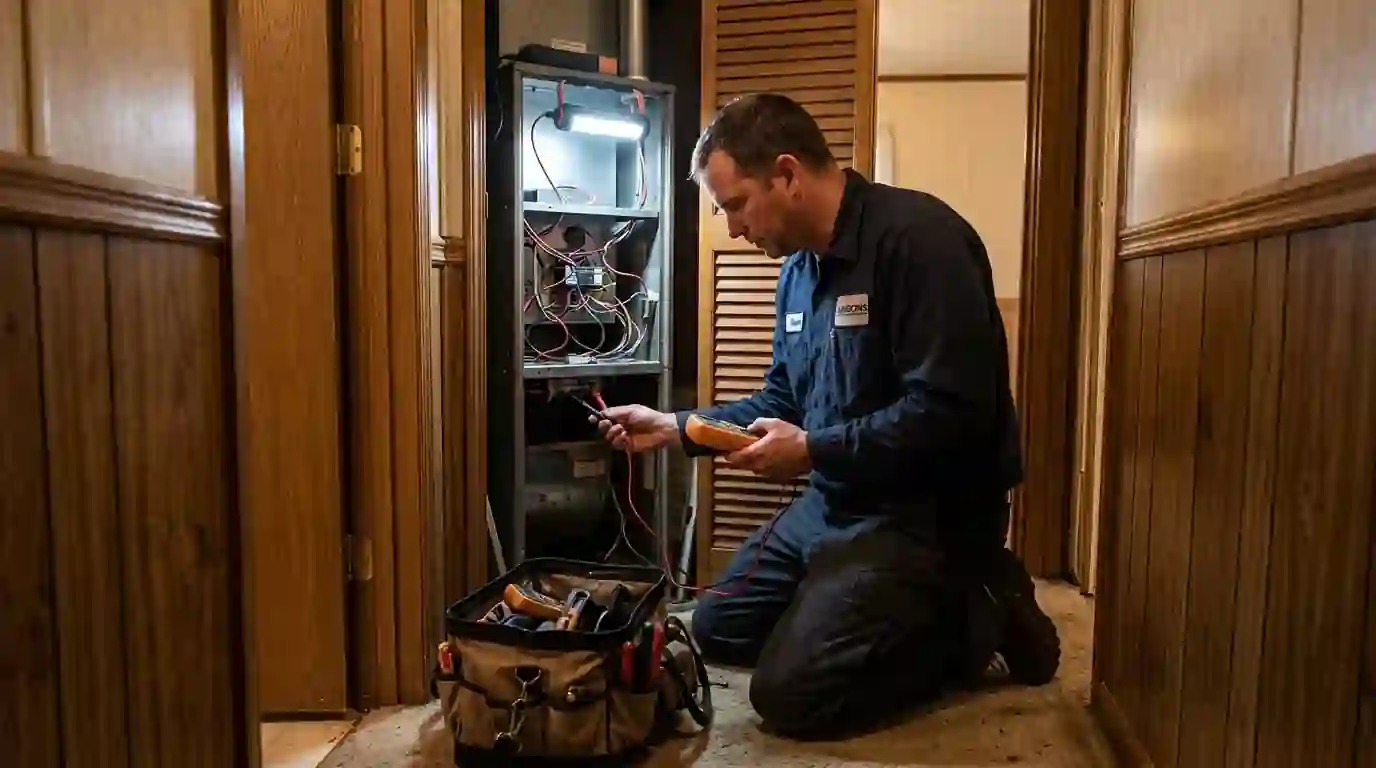
Mobile home HVAC service covers the downflow furnace in the hall closet, the belly trunk duct under the floor, the crossover duct on double-wides, and any AC or heat pump tied in. We most often find torn belly board, a loose crossover, a leaking roof jack or a failed igniter. Repairs usually run $185 to $895; a downflow furnace replacement runs $2,985 to $5,495.
A manufactured home moves heat in its own way. The furnace stands in a small closet, usually in the hallway, and blows warm air straight down through the floor into a trunk duct that runs the length of the home inside the belly, the insulated cavity under the floor wrapped in a fabric or plastic bottom board. Return air comes back through louvers in the closet door instead of through return ducts. On a double-wide, a flexible crossover duct carries air from one half to the other underneath the home.
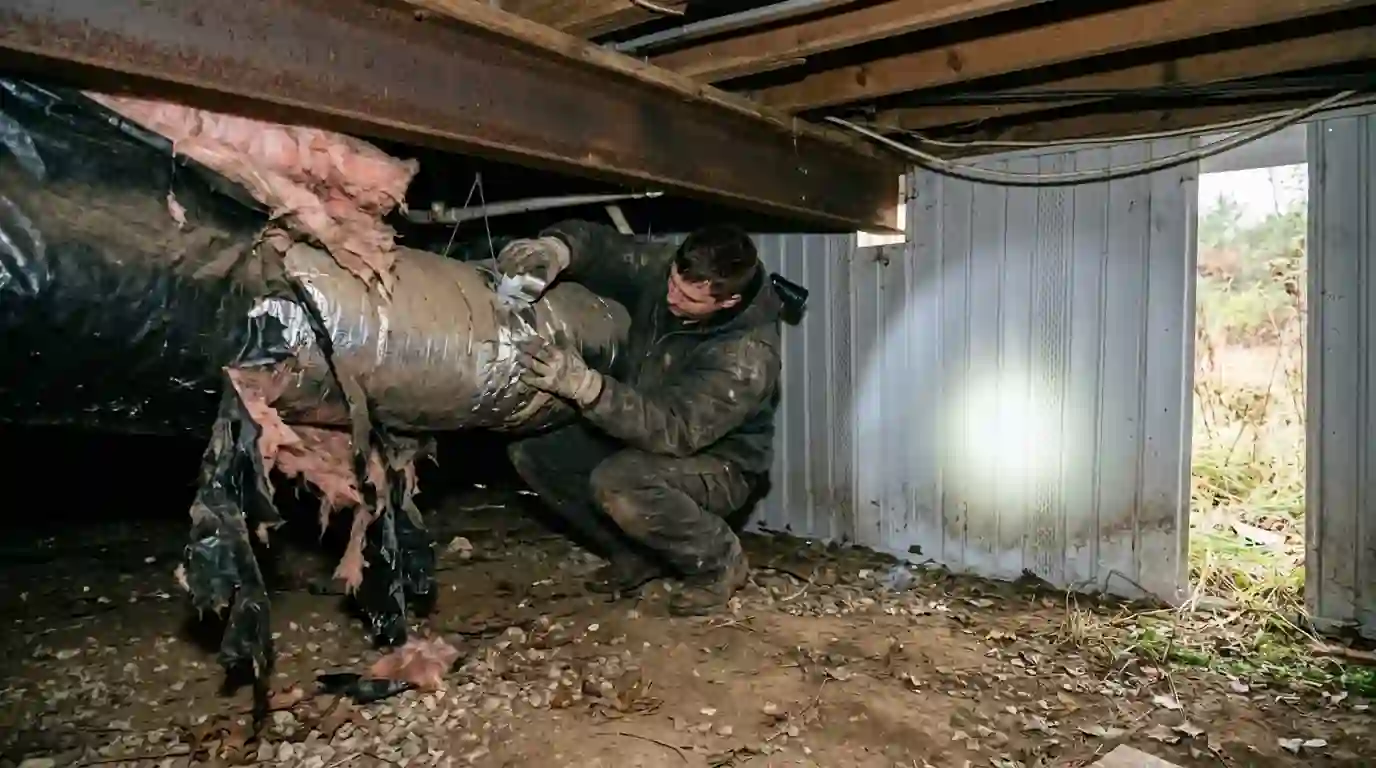
Because of that layout, a problem under the floor looks like a furnace problem from inside the house. A crossover that slipped off its collar, a trunk torn open by a raccoon, or belly insulation hanging in the dirt will leave one end of the home cold while the furnace runs fine. Landcons technicians check the closet, the roof jack and the crawl space under the skirting on every manufactured home call, so you pay to fix the part that actually failed and not a guess.
Signs the heat or air in your manufactured home needs attention
Some of these come from the furnace itself and some come from the ducts under the floor. We test both before we recommend anything.
One end of the home stays cold
The furnace runs long cycles but the bedrooms at the far end or the second half of a double-wide never catch up. That usually points to a disconnected crossover or a split in the belly trunk.
Weak air at the floor registers
Registers near the closet blow hard and the ones farther away barely flutter. Crushed ducts, rusted register boots or a closet door with blocked louvers are common causes.
Water stains on the furnace or closet ceiling
Rust on top of the cabinet or a stained ceiling around the vent pipe means the roof jack is letting water in.
Burners that light and drop out
A sealed combustion furnace that lights, runs a few seconds and shuts off often has a dirty flame sensor or a blocked intake. Snow drifted over a roof jack can cause the same lockout.
Cold floors and frozen water lines
Torn bottom board lets cold air and animals into the belly, which chills the floor and can freeze supply lines. The ducts in that cavity lose heat the same way.
Wet ground or ice under the home in summer
An AC coil drain that empties into the belly or under the skirting soaks insulation and rusts the trunk.
How we work on a manufactured home system from roof to belly
Each visit follows the air and the combustion path the whole way through. That is how we find faults that hide under the floor.
Check the furnace label and the closet
We confirm the furnace data plate shows it is listed for manufactured home use and note the fuel, input and age. We also check the closet door louvers, since a blocked return starves the blower.
Run and test the heating sequence
We call for heat and watch the inducer, igniter, gas valve and flame sensor with meter leads attached, or the heating element sequencers on an electric furnace. On propane units we measure gas pressure at the valve.
Inspect the roof jack and venting
Sealed combustion furnaces pull outside air and push exhaust through a concentric roof jack or a vent through the floor. We look for loose sections, missing caps, failed flashing and any sign of exhaust leaking into the closet.
Crawl the belly and the crossover
We go under the skirting with a light and a camera, check every trunk joint and register boot, and confirm the crossover is attached, supported off the ground and insulated. Torn bottom board gets patched once the duct behind it is sealed.
Check cooling, drains and clearances
If the home has AC or a heat pump, we test the coil box, refrigerant pressures and the condensate line, then confirm the outdoor unit has room to breathe outside the skirting. Last, we check carbon monoxide at the furnace and in the hallway.
What mobile home furnace and AC work typically costs
These ranges cover the jobs we do most often in manufactured homes. The diagnostic visit is quoted before we start.
| Item | Typical range |
|---|---|
| Diagnostic visit, weekday hours | $89 to $149 |
| Propane conversion kit on a new furnace | $185 to $395 |
| Crossover duct replacement or reconnection | $245 to $895 |
| Belly trunk repair with bottom board patch | $285 to $1,185 |
| Downflow furnace replacement, manufactured home listed | $2,985 to $5,495 |
| Split AC added with coil box under the furnace | $3,985 to $7,495 |
What moves the price
- Gas and propane downflow furnaces cost more than electric ones, and sealed combustion models need a matching roof jack kit.
- Reusing a sound roof jack keeps the price down, while a rusted or leaking one gets replaced with new flashing.
- A double-wide with a long crossover run takes more time under the floor than a single-wide.
- Low skirting clearance, standing water or tight access under the home add labor time.
These are typical ranges for this market, not quotes. Our technician prices the job after inspecting the closet, roof and belly, and you approve it before any work starts. See every range in one place in our HVAC price guide.
Why manufactured homes in northeast Indiana need a different winter plan
Manufactured homes sit closer to the weather than a basement house does. With January nights averaging about 17°F and real wind across open farmland, the belly under the floor is the first thing to get cold, and any gap in the bottom board turns into a draft through every floor register. Out in Allen, Adams, Wells and Noble counties, many homes sit on rural lots where wind tears skirting loose and animals look for a warm spot under the floor.
Fuel is the other local wrinkle. Homes in town or inside the city often have natural gas from NIPSCO, but a lot of rural manufactured homes run on propane from a tank in the yard, and some older ones heat with an electric furnace on Indiana Michigan Power. Each fuel changes the repair and the operating cost. We carry propane conversion parts on the truck, and we can tell you whether a heat pump added to an electric furnace makes sense for your bill before you spend anything.
Quick checks before you call about a manufactured home furnace
A few of these clear up the problem on their own, and the rest help us arrive with the right parts.
- Set the thermostat to Heat and a few degrees above room temperature, and replace its batteries if the screen is faint.
- Open the closet door or clear anything stacked against the louvers, since that door is the return air path.
- Pull the filter, which often sits behind the closet door above the furnace, and replace it if it is caked with dust.
- Check the furnace breaker and the service switch near the closet, and reset a tripped breaker only once.
- On propane heat, look at the tank gauge, because a tank below about 20 percent can starve the furnace in deep cold.
- After heavy snow, look at the roof jack from the ground to see whether it is buried or iced over.
- Walk the skirting and note any loose panels or insulation hanging under the home.
Downflow gas, electric with heat pump, or a package unit
Most manufactured homes we see run one of these three setups, and each one suits a different fuel and budget.
| Option | Best for | Keep in mind |
|---|---|---|
| Downflow gas or propane furnace in the closet | Homes with natural gas service or a yard tank that want strong heat in deep cold | Must be listed for manufactured homes with a sealed combustion roof jack; cooling is added later with a coil box and outdoor unit. |
| Electric downflow furnace paired with a heat pump | All-electric homes with no gas line that want lower heating bills and central air | The heat pump carries most of the heating, and the electric elements cover the coldest nights, so the panel must handle both loads. |
| Package unit on a pad outside the skirting | Homes with a cramped or damaged furnace closet, or owners who want heating and cooling in one cabinet | Ducts pass through the skirting into the belly trunk, so those connections need sealing and insulation. |
Brands we work on
We service Carrier, Trane, Lennox, Goodman, Rheem and every other major make, plus WaterFurnace geothermal units built here in Fort Wayne.
Areas we cover for this service
We run this work across Fort Wayne and the towns around it. These are the places we are called to most; if your town is not listed, call and ask.
Mobile Home Furnace & AC questions we hear often
Can any furnace be installed in a mobile or manufactured home?
No. Manufactured homes built to the HUD code need a furnace listed for manufactured home use, which means a downflow design with sealed combustion that takes all its air from outside. A standard basement furnace draws combustion air from the room and does not meet that rule. We install only furnaces labeled for manufactured housing, with the matching roof jack or floor vent kit.
Why is one half of my double-wide manufactured home colder than the other?
The usual cause is the crossover duct under the home. It is a flexible insulated duct that carries air from the furnace side to the other half, and it can slip off its collar, sag onto the ground, or get crushed. Once it is reattached, strapped up and insulated, the far half usually heats evenly again within a cycle or two.
Can you add central air to a mobile home that only has a furnace?
Usually, yes. On most downflow furnaces we add an evaporator coil in a coil box under the furnace, set an outdoor condenser on a pad outside the skirting, run the refrigerant lines and a new circuit, and route the condensate drain outside. A heat pump can go in the same way and also cut heating costs on an electric furnace.
Should a manufactured home in the rural counties heat with propane or electric?
It depends on what is already there and what fuel costs locally. Propane furnaces give strong heat on the coldest nights but depend on tank deliveries. An electric furnace is simple to own but costly to run alone, which is why we often pair it with a heat pump. We compare your actual bills and options before recommending either.
How long does a mobile home furnace replacement take?
Most manufactured home furnace swaps take four to seven hours. That covers removing the old unit, setting the new downflow furnace on its floor base, connecting gas or wiring, fitting the roof jack, and testing. If the belly trunk or crossover needs repair, or a propane conversion is needed, plan on most of the day.