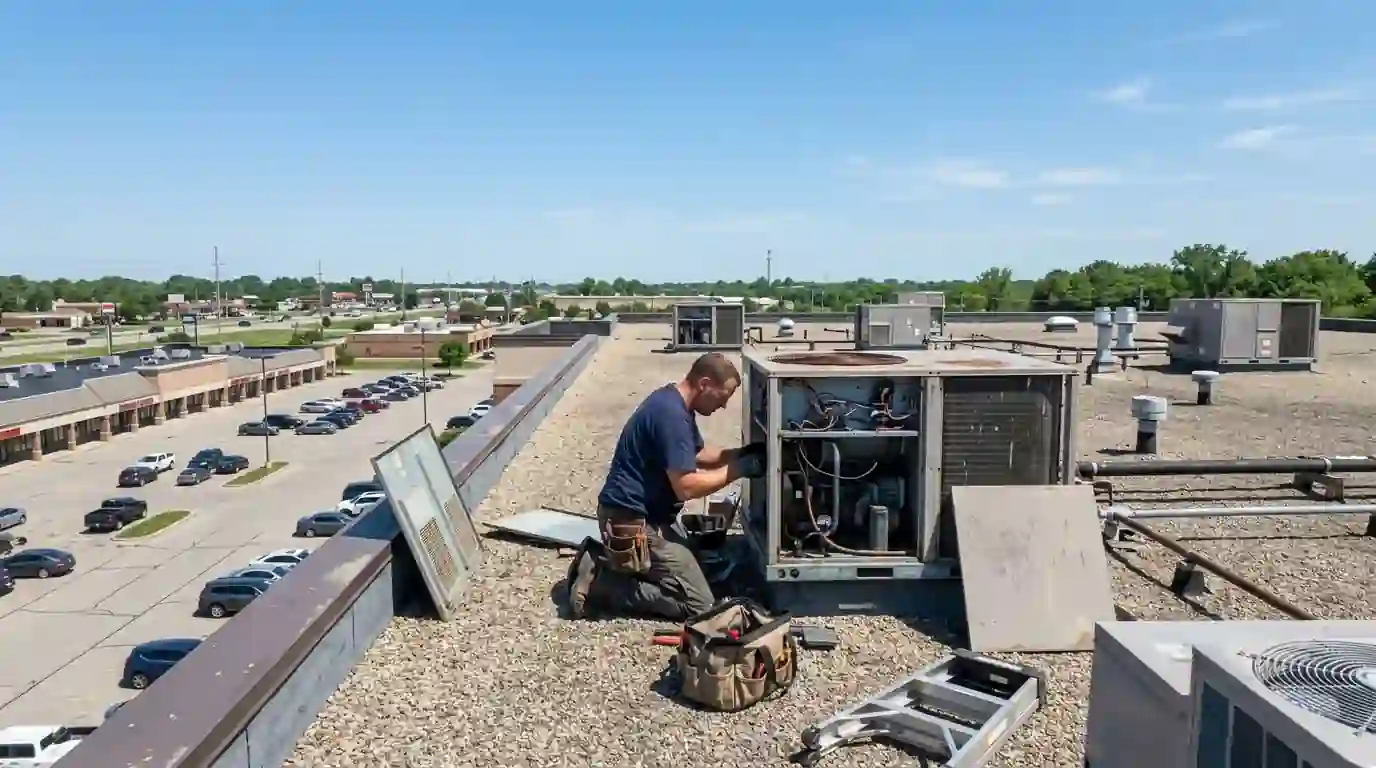
Commercial HVAC service covers repair, maintenance and replacement of rooftop units, commercial split systems and gas unit heaters for shops, offices, restaurants and small warehouses. We usually find failed capacitors, stuck economizer dampers, dirty coils, belt problems and ignition faults. A typical rooftop service call runs $149 to $249, and we answer 24/7.
Light commercial buildings use different equipment than houses. Most strip-center shops, offices and restaurants run packaged rooftop units that combine gas heat, cooling and a blower in one cabinet on the roof. Warehouses and auto shops lean on gas-fired unit heaters hung from the ceiling, and some offices use split systems with an air handler above a drop ceiling. Each type has its own common failures, and rooftop units take a beating from wind, snow and summer sun.
Our technician works on all of it: no heat, no cooling, units that run but do not keep up, and economizers that let in too much outside air. We carry belts, capacitors, contactors, igniters and filters in common sizes, so many calls end with the unit running the same day. When a unit is at the end of its life, we help you plan a replacement that fits the curb on the roof and your operating hours, including crane scheduling where needed.
Commercial HVAC problems we fix most
These are the calls that come from business owners and property managers most often.
Rooftop unit blowing warm air
A failed capacitor, a tripped high-pressure switch or a dirty condenser coil are the usual suspects. Restaurants with grease-laden air see coils plug fast.
Economizer stuck open or closed
Rooftop economizers bring in outside air when it is cool enough to use. A failed actuator or sensor can flood the space with cold or humid air, or never open at all.
Unit heater will not light
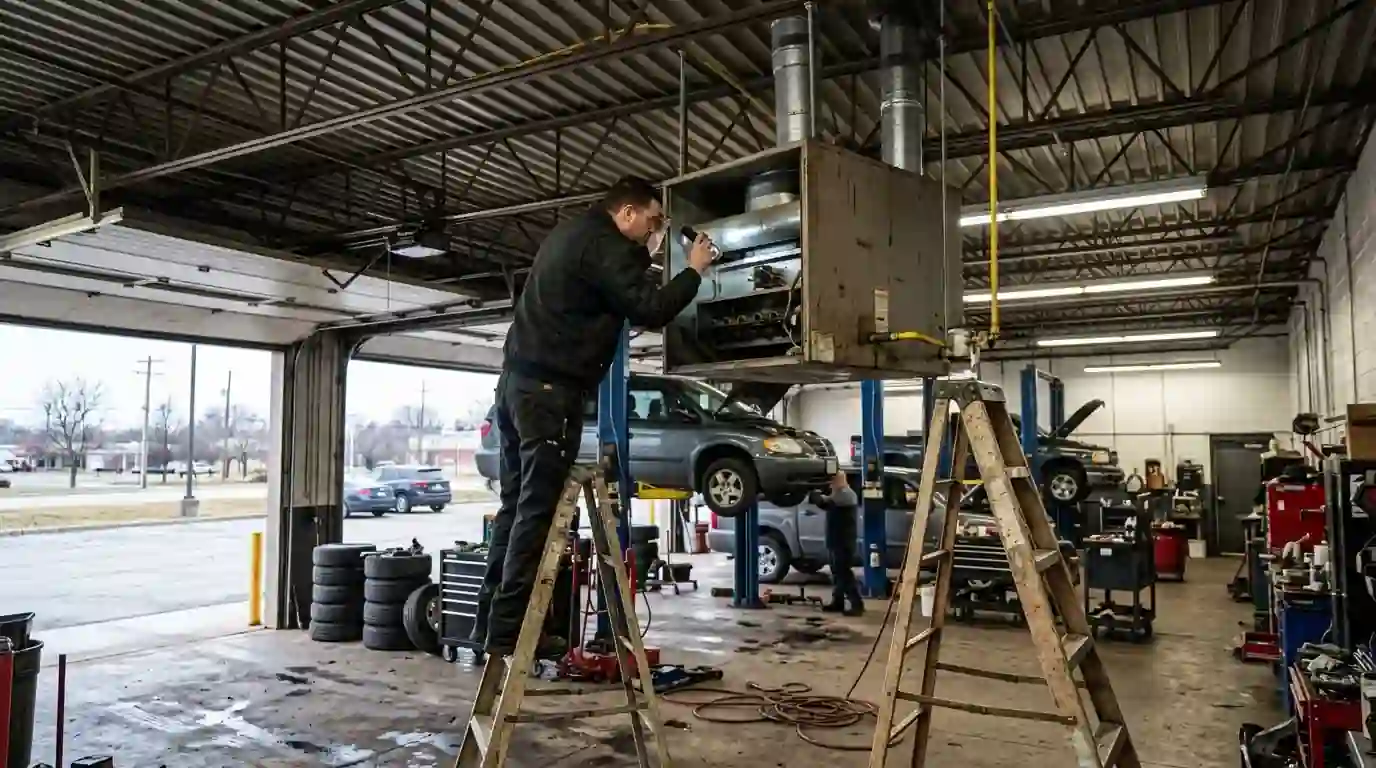
Shop unit heaters fail at the igniter, flame sensor, inducer or gas valve. Dust and oil mist in the air make sensors foul faster than in homes.
Squealing or slapping belts
Belt-drive blowers in rooftop units need belt tension and pulley alignment checked. A thrown belt means no airflow at all.
Water leaking through the ceiling
Clogged condensate drains and traps on rooftop units overflow into drop ceilings. Roof curb leaks can look the same.
One area of the space too hot or cold
Open offices and dining rooms often share one unit. Zoning, duct balancing or a second unit may be needed.
How we handle a commercial service call
We work around your business hours as much as the problem allows.
Talk to the person on site
We ask which units serve which areas and what changed. Many buildings have several identical rooftop units, so knowing which one serves the problem area saves time.
Diagnose at the unit
On the roof or at the heater, we check power, controls, safeties, burners, refrigerant pressures and airflow. We test before replacing parts.
Repair from the truck when possible
Common parts like capacitors, contactors, belts and igniters are often on hand. Larger parts are ordered and we tell you the timeline.
Check the economizer and controls
We confirm the economizer damper moves, the outside air sensor reads correctly and the thermostat or building control is calling properly.
Document for the property manager
You get a written note of what failed, what we did and what to watch. Multi-tenant buildings can share it with the owner.
Typical commercial HVAC service and replacement costs
Commercial pricing depends heavily on equipment size and access.
| Item | Typical range |
|---|---|
| Rooftop unit service call and diagnosis | $149 to $249 |
| Capacitor, contactor or belt replacement | $175 to $395 |
| Economizer actuator or sensor replacement | $385 to $895 |
| Unit heater repair, igniter or inducer | $245 to $945 |
| Rooftop unit replacement, 3 to 10 tons | $8,985 to $21,495 |
| Gas unit heater replacement | $1,685 to $3,895 |
What moves the price
- Unit size in tons and whether it is gas heat, electric heat or heat pump.
- Roof access, ladder or lift needs, and crane rental for replacements.
- Curb adapters when a new rooftop unit does not match the old curb.
- After-hours work to avoid disrupting business.
- Refrigerant type, especially on older R-22 units.
These are typical ranges for light commercial work. The actual price is set after our technician sees the equipment and the site. See every range in one place in our HVAC price guide.
Commercial HVAC across Fort Wayne's business corridors
The city has a long industrial history, from the motor plants at the old GE works on Broadway (now the Electric Works redevelopment) to the manufacturing and distribution buildings along the major highways today. Most of our commercial calls come from the smaller buildings around them: machine shops, auto repair bays, contractor shops and pole barns heated with ceiling unit heaters, plus the offices, clinics and restaurants in strip centers and along the commercial corridors. Those businesses cannot shut down for a week waiting on parts. A clinic needs steady temperatures for patients, a restaurant needs its kitchen makeup air working, and a machine shop needs heat so coolant and hydraulic oil stay workable on winter mornings.
Weather drives the call volume. When January nights drop near 17°F, unit heaters in uninsulated shops run nonstop and failed igniters or inducers become same-day emergencies to keep pipes and products from freezing. Snow piles on rooftop units and blocks condenser and combustion air openings. In humid July, restaurant kitchens and crowded dining rooms push rooftop units to their limit, and economizers left stuck open let muggy outdoor air pour in. Cottonwood fluff and parking lot dust coat condenser coils in early summer, so a spring coil cleaning on each rooftop unit pays for itself in fewer high-pressure trips. Older units still running R-22 are worth planning around now, since that refrigerant is no longer produced and every recharge gets more expensive.
What business owners can do to avoid a shutdown
A few habits keep commercial equipment running between service visits.
- Keep a list of each rooftop unit and which part of the building it serves.
- Change filters on a set schedule; restaurants and shops may need it monthly.
- Keep the area under unit heaters clear of stacked materials and flammables.
- Clear snow from around rooftop unit intakes and condenser coils after storms.
- Watch for water stains on ceiling tiles near rooftop units.
- Make sure the roof hatch and ladder are open and reachable when you call.
- Set thermostats to setback after hours but not off in winter.
- Schedule spring and fall service before the seasonal rush.
- Keep the gas shutoff for each unit heater labeled and reachable.
Rooftop units, split systems and unit heaters compared
Most light commercial buildings use one or more of these.
| Option | Best for | Keep in mind |
|---|---|---|
| Packaged rooftop unit | Retail, offices and restaurants with flat roofs | Exposed to weather; replacement often needs a crane |
| Commercial split system | Offices and clinics with space for an indoor air handler | Longer refrigerant lines and more indoor space needed |
| Gas unit heater | Shops, garages, warehouses and pole barns | Heat only; needs proper venting and clearance to combustibles |
| Ductless mini-split | Server rooms, small offices and add-on spaces | Limited ventilation and filtration |
Brands we work on
We service Carrier, Trane, Lennox, Goodman, Rheem and every other major make, plus WaterFurnace geothermal units built here in Fort Wayne.
Areas we cover for this service
We run this work across Fort Wayne and the towns around it. These are the places we are called to most; if your town is not listed, call and ask.
Commercial HVAC questions we hear often
Do you provide commercial HVAC service after business hours?
Yes. We answer 24/7, including weekends and holidays. Many commercial repairs are best done after close or before opening so the business is not disrupted. After-hours rates apply for nights, weekends and holidays, and we tell you the rate before we roll.
How long do commercial rooftop units usually last?
Most rooftop units last about 15 to 20 years with regular service, less in harsh conditions like restaurants with grease-laden air. Rust on the cabinet, cracked heat exchangers and repeated compressor issues are signs replacement is near. We can help you plan replacements so they are not forced on you in July.
What does a rooftop economizer do and why does it fail?
An economizer opens a damper to cool the space with outside air when it is cool and dry enough, so the compressor can rest. Actuators, sensors and linkages wear out, and dampers rust. A stuck-open economizer can flood the space with cold or humid air; a stuck-closed one wastes energy. We check it on every rooftop visit.
Can you replace a rooftop unit without changing the roof curb?
Sometimes. If the new unit matches the old footprint, it sits right on the existing curb. Otherwise we use a curb adapter, which avoids cutting the roof. We measure the curb, ductwork openings and gas and electrical connections before ordering so the swap goes quickly.
What size unit heater does a shop or garage need?
It depends on the square footage, ceiling height, insulation and how often overhead doors open. An uninsulated pole barn needs far more heat than an insulated shop of the same size. We calculate the load and place the heater so warm air reaches the work area, not just the ceiling.