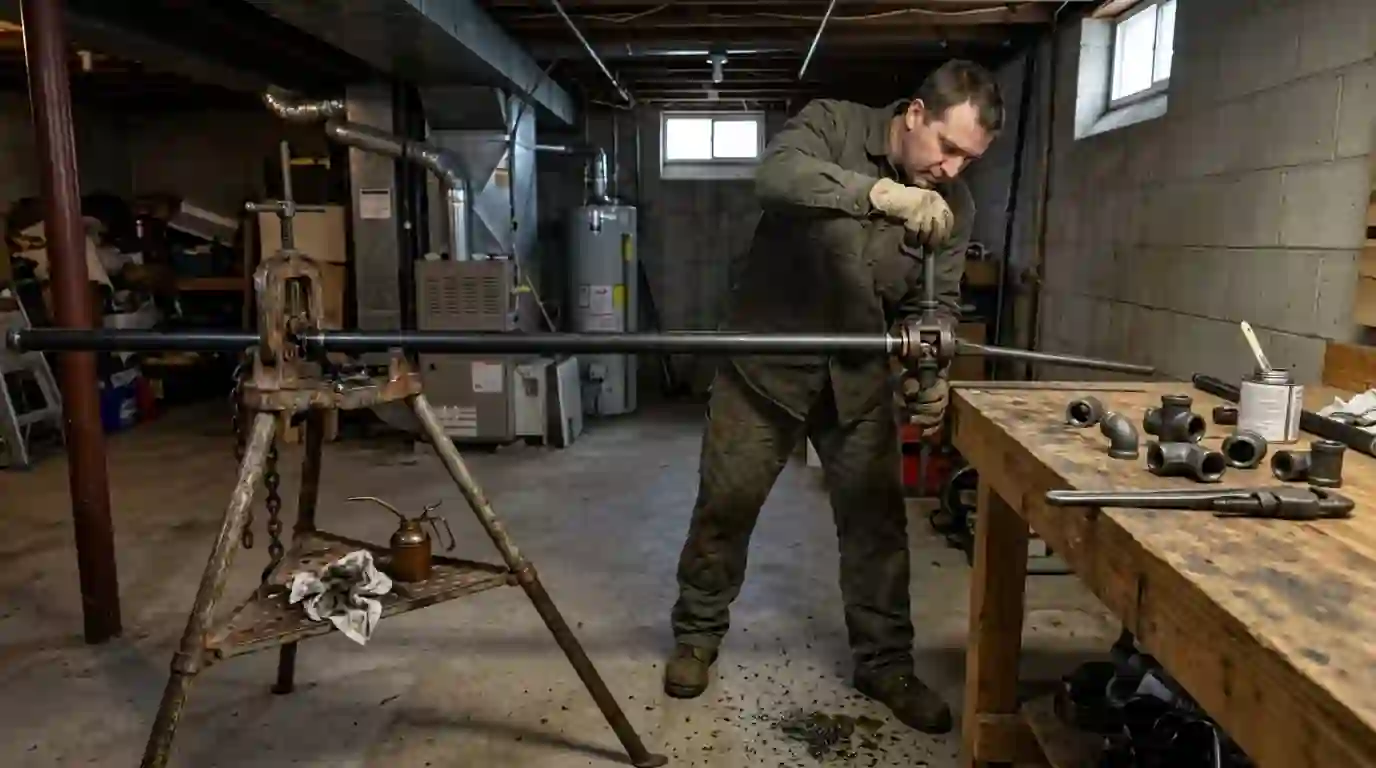
Gas line service covers new piping runs, extensions, leak repairs and line upsizing for appliances like furnaces, ranges, dryers, generators and unit heaters. We usually work with black iron pipe or CSST with proper bonding. A typical gas line run costs $285 to $1,195, and most jobs finish in a day, including a pressure test.
Gas piping looks simple, but every run has to be sized for the total load of every appliance on it and the length from the meter. An undersized line works fine when one appliance runs and starves the others when two fire at once. That is why a new tankless water heater or a second furnace can cause problems with an existing range. We calculate the load in BTUs per hour and choose pipe size from the code tables, not from what happened to be on the truck.
We install black iron pipe for main runs and exposed basement work, and CSST (corrugated stainless steel tubing) where flexible routing through walls and joists makes sense. CSST needs a bonding clamp and conductor tied to the electrical grounding system, because nearby lightning strikes can damage tubing that lacks one. Every new or modified line gets a shutoff valve and a sediment trap at the appliance, plus a pressure test before we turn on the gas.
Black iron, CSST or buried poly: which pipe goes where
Each material has a place, and code decides some of it for you.
| Option | Best for | Keep in mind |
|---|---|---|
| Black iron pipe | Main runs, exposed basement work and meter connections | Labor-heavy to thread and route around obstacles |
| CSST | Long runs through finished walls and joist bays | Needs a bonding clamp and striker plates at framing |
| Underground polyethylene | Buried runs to detached garages and outbuildings | Needs tracer wire and approved risers at each end |
When you need gas line work
These are the reasons people call us for gas piping.
A new gas appliance
A range, dryer, fireplace insert or grill hookup needs a properly sized branch with a shutoff valve. We run it from the nearest suitable point on the system.
A garage or shop heater
Unit heaters often need a long run from the basement to a detached or attached garage. Pipe size grows with distance.
A standby generator
Generators use a lot of gas at full load. The line and sometimes the meter have to support it alongside the furnace and water heater.
Appliances that act up together
If the furnace flame drops when the range or water heater fires, the line may be undersized for the combined load.
A gas smell near piping
A faint smell at a fitting points to a leak. Leave the home, call NIPSCO from outside, then call us to repair it.
CSST without a bonding clamp
Yellow-jacketed CSST without a bonding clamp near the meter or manifold needs one added. We check this during any gas visit.
How a gas line job goes from plan to pressure test
Gas work follows a strict order, and we do not skip steps.
Load and route
We add up the BTU rating of every appliance on the system, measure the run length and pick the pipe size and route.
Permit
New gas piping generally requires a permit through the local building department. We file it and schedule the inspection.
Install the piping
Black iron gets threaded, doped and supported at the right spacing; CSST gets run with protective striker plates where it passes through framing. Each appliance gets a shutoff valve and a drip leg.
Bond and pressure test
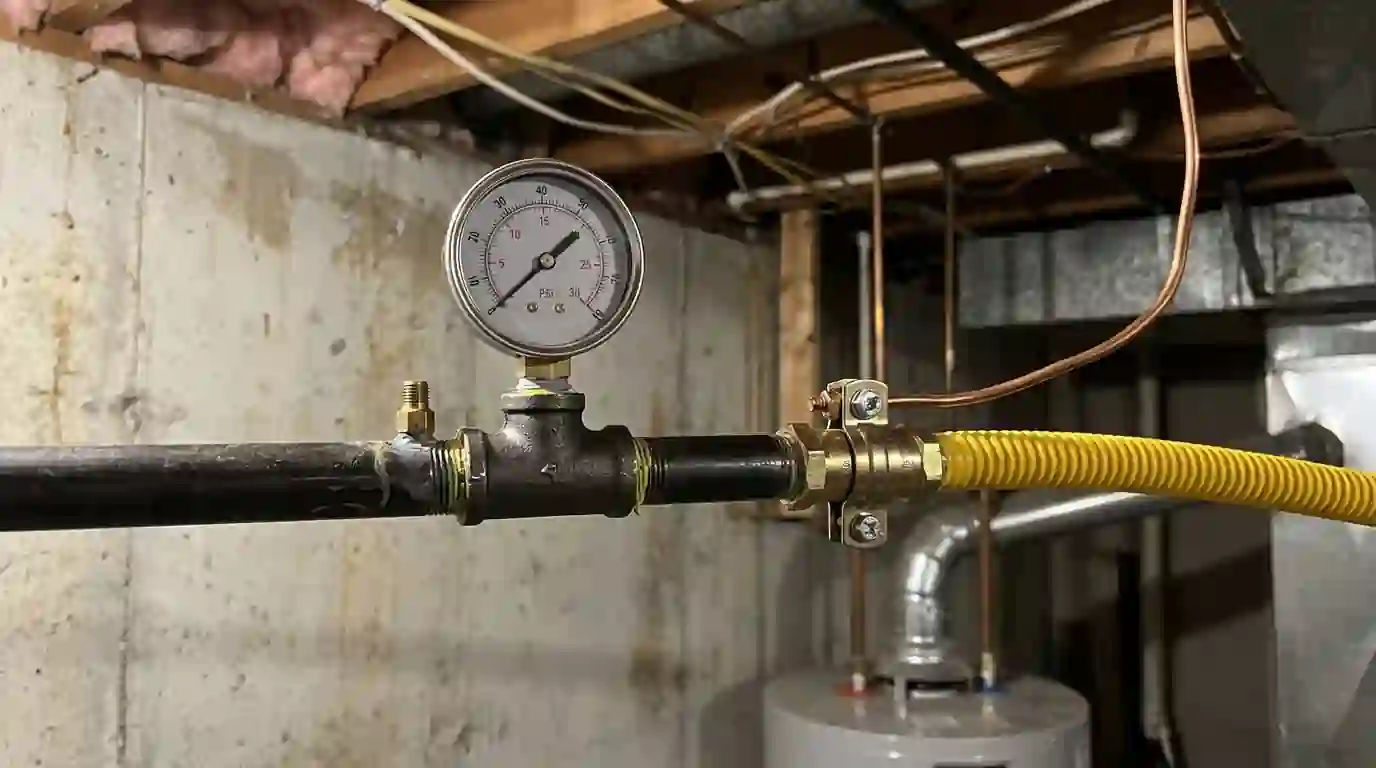
CSST gets its bonding clamp and conductor to the grounding system. The new piping is capped and held under air pressure on a gauge to prove it does not leak.
Connect, purge and light
We connect the appliance, purge air from the line, light it and check every joint with leak detector solution. Then we check burner operation and venting.
Inspection
Where required, the inspector checks the work before it is closed in or fully put into service.
Walk through the shutoffs
We show you where each new valve is and how to close it, along with the main shutoff at the meter.
Gas piping in Fort Wayne homes, garages and rural lots
NIPSCO delivers natural gas across most of Fort Wayne and Allen County, and the utility owns the meter and the service line up to it. Everything past the meter is the homeowner's piping, and that is where we work. In the older central neighborhoods, we still find original black iron with old fittings, abandoned branches to appliances long gone and capped lines inside walls. When we add a new appliance in those homes, we check that old piping and remove dead branches where it makes sense. Post-war ranches on the north and east sides usually have a simple black iron trunk across the basement ceiling, which makes tapping in a new branch straightforward as long as the trunk is big enough.
Out in rural Allen, Whitley and Noble counties, many homes run on propane from a tank on the property. Propane runs at different pressures and BTU values than natural gas, so pipe sizing and appliance orifices differ. We size propane piping to the tank regulator and convert appliances where needed. Detached garages and pole barns are common out there, and running gas to a shop heater often means a buried line with tracer wire. When a farmhouse switches from propane to natural gas after a main is extended, every appliance needs its orifices or conversion kit changed, and we handle that along with the piping.
Gas line service pricing
Length, pipe size and access set most of the price.
| Item | Typical range |
|---|---|
| Short run to a range or dryer in an open basement | $285 to $595 |
| Longer run to a garage heater or fireplace | $545 to $1,195 |
| Generator gas line with sizing check | $685 to $1,895 |
| Leak search and fitting repair | $189 to $485 |
| CSST bonding to the grounding system | $185 to $395 |
What moves the price
- Total run length and the pipe size the load requires.
- Finished ceilings or walls that have to be opened and patched.
- Buried lines to detached garages or outbuildings.
- Permit and inspection requirements for the job.
- Whether existing piping has to be upsized to support the new load.
- Propane conversions or regulator changes on rural systems.
These are typical ranges. The visit sets the real price after we measure the route and calculate the gas load. See every range in one place in our HVAC price guide.
Gas safety habits for every household
Keep these in mind whether or not you are adding a line.
- Know where your main gas shutoff is at the meter and keep a wrench nearby.
- Keep working carbon monoxide alarms on every level of the house.
- Never hang anything on gas piping or use it to support storage shelves.
- Keep snow and ice cleared from around the gas meter in winter.
- Call 811 before digging anywhere on your property.
- If you smell gas, leave first, then call NIPSCO from outside.
- Do not connect an appliance with an old or reused flexible connector.
- Ask whether any CSST in your home has a bonding clamp.
Brands we work on
We service Carrier, Trane, Lennox, Goodman, Rheem and every other major make, plus WaterFurnace geothermal units built here in Fort Wayne.
Areas we cover for this service
We run this work across Fort Wayne and the towns around it. These are the places we are called to most; if your town is not listed, call and ask.
Gas Line Services questions we hear often
Do I need a permit for gas line services on my home?
In most cases, yes. New piping and extensions typically need a permit and inspection through the local building department in Allen County and the surrounding counties. We pull the permit, do the work to code and arrange the inspection, so you are covered when it comes time to sell.
Can my existing gas line handle a tankless water heater or generator?
Not always. Tankless heaters and standby generators draw a lot of gas at full output. We total the BTU load of every appliance and measure pipe length to find out. Sometimes a dedicated line from the meter is needed, and sometimes NIPSCO has to change the meter.
Is CSST gas piping safe?
CSST is approved and widely used, and it performs well when installed correctly with proper bonding. The main concern is lightning: a nearby strike can arc through tubing that lacks bonding. Bonding it to the electrical grounding system with the right clamp and wire is the fix, and we check for it.
What should I do if I smell gas near a pipe?
Leave the house right away without flipping switches or using a phone inside. From outside, call NIPSCO's emergency line or 911. Once the utility has made it safe, call us to find and repair the leak, then pressure test the system before the gas goes back on.
Can you run a gas line to my detached garage?
Yes. We usually run buried polyethylene pipe with a tracer wire between approved risers, sized for the heater and the distance. Before digging we call 811 to mark utilities. Inside the garage, the heater gets its own shutoff valve and a sediment trap.