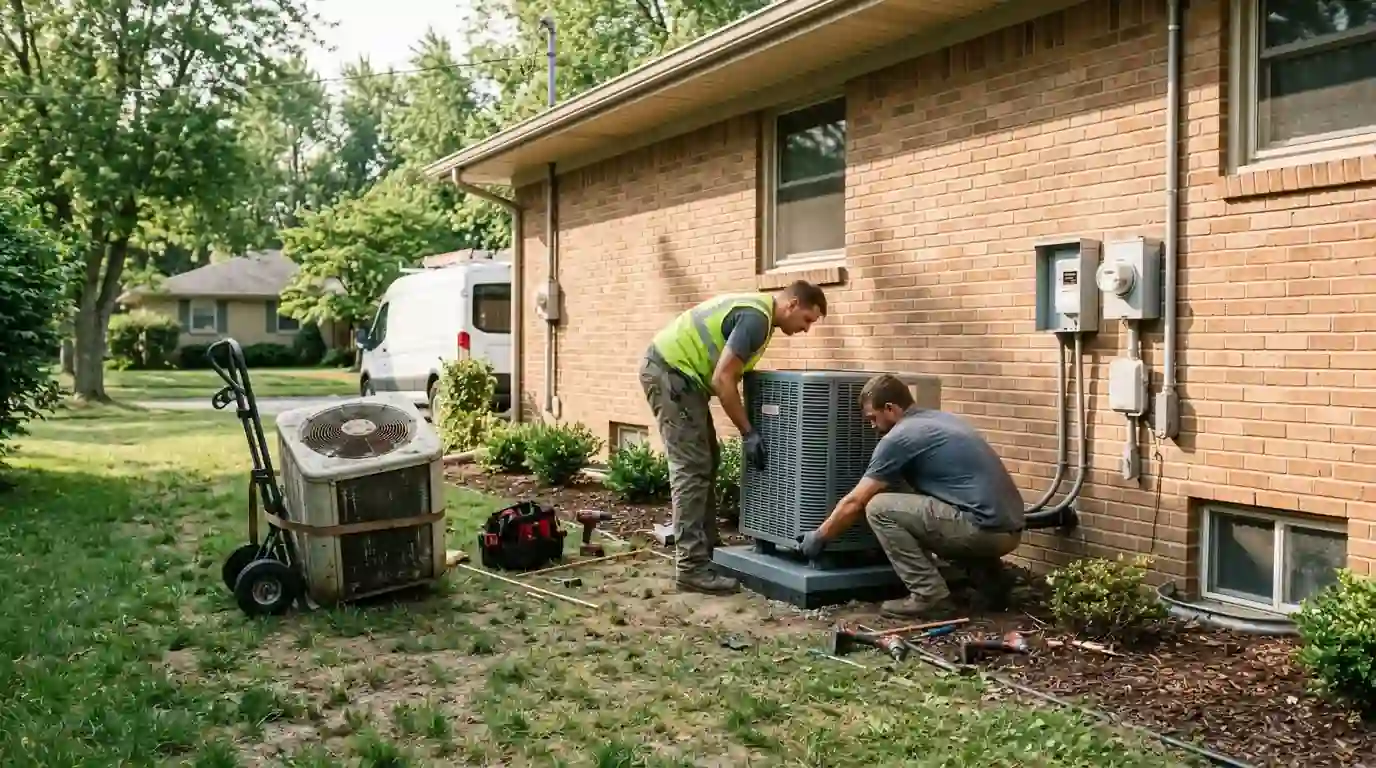
AC installation means replacing the outdoor condenser and, in most cases, the matching indoor coil, sized with a room-by-room load calculation. New systems use R-454B or R-32 refrigerant and are rated by SEER2. Typical central air replacement in this area runs $4,285 to $9,795, and most installs are finished in one day.
The biggest mistake in AC replacement is copying the tonnage on the old unit. Many homes around here got an oversized air conditioner decades ago, and since then the owners have added insulation, replaced windows or finished the basement. An oversized system cools the air fast, shuts off before it pulls the moisture out, and leaves the house feeling damp at 74°F. A Manual J load calculation fixes that by working out how many Btu per hour your house actually gains on a design summer day.
Landcons also looks at what the new equipment connects to. The indoor coil has to match the condenser and the refrigerant, the furnace blower has to move enough air for the new tonnage, the line set has to be the right size and clean, and the condensate drain has to handle a humid July. We check each of those before we quote, so the price you see covers the job that actually needs doing.
Single-stage, two-stage and variable-speed AC compared
The staging of the compressor matters more to comfort than most people expect.
| Option | Best for | Keep in mind |
|---|---|---|
| Single-stage central air | Budget-focused replacements and smaller homes | Runs full blast or off, so humidity control is fair at best |
| Two-stage central air | Most local homes with basements and humid summers | Costs more up front but runs long low cycles that dry the air |
| Variable-speed (inverter) central air | Larger homes, uneven upstairs rooms, people who want the quietest system | Highest price and needs a compatible thermostat and blower |
Signs your central air is ready to be replaced
Age alone does not decide it. These conditions together usually do.
The system uses R-22 refrigerant
R-22 production ended in 2020, so any leak on an older system means scarce, expensive recovered refrigerant. Most units installed before about 2010 fall into this group.
It needs a recharge every summer
Topping off refrigerant year after year means a leak in a coil or line set that will not fix itself. Past a certain point, the money is better spent on a new matched system.
The compressor is failing
A compressor that trips on overload, draws high amps or will not start without a hard-start kit is near the end. On a unit past 12 to 15 years, compressor replacement rarely makes financial sense.
Summer electric bills keep climbing
Older 10 SEER units use a lot more power than current equipment rated at 13.4 SEER2 or above. Worn coils and weak compressors make the gap bigger every year.
Rooms are uneven and the house feels sticky
If the upstairs stays hot and the house stays humid even with the AC running, the system may be the wrong size or the duct design may need attention. We look at both before choosing new equipment.
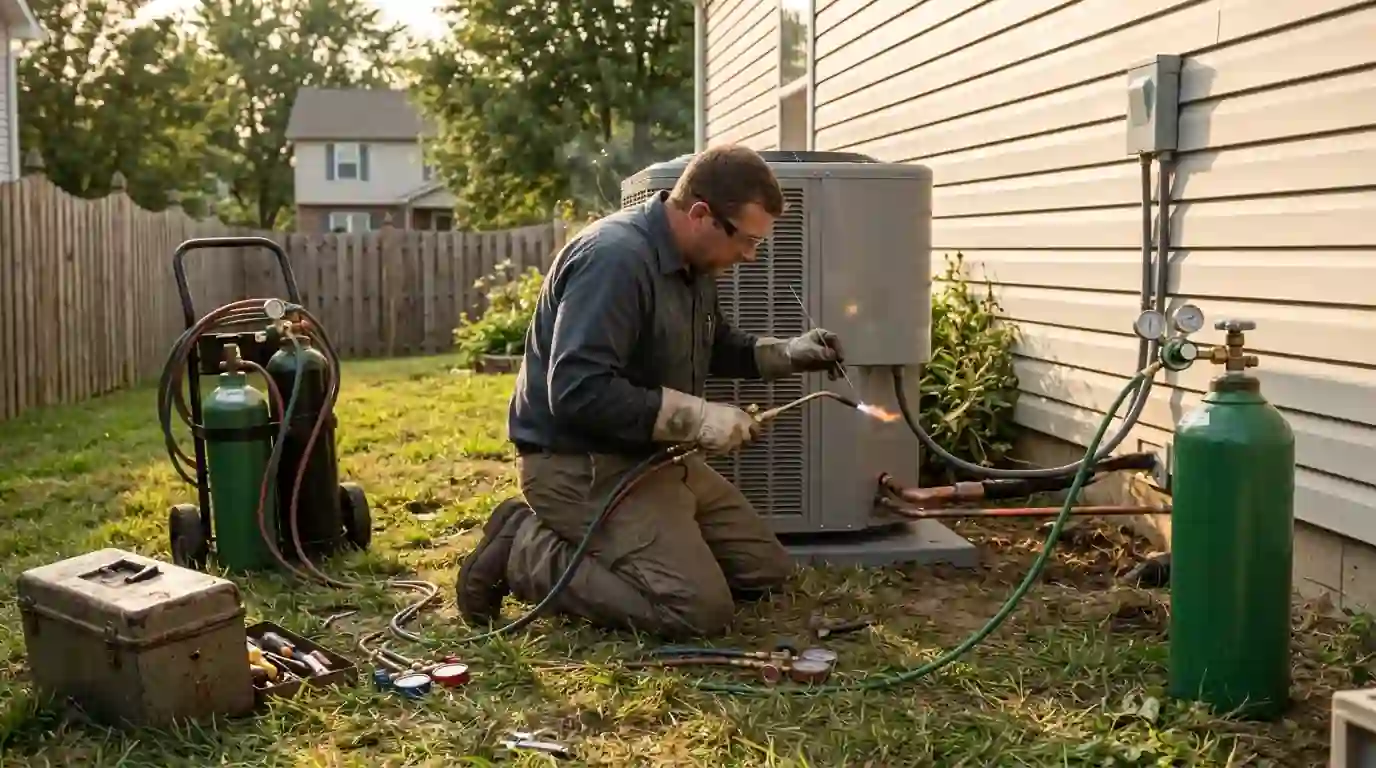
How a Landcons AC installation goes, from quote to startup
A good install is mostly preparation and verification. These are the steps we take on every replacement.
Load calculation and duct check
We measure rooms, windows and insulation for a Manual J calculation and look at your supply and return ducts. If the ducts are too small for the tonnage the house needs, we tell you before you buy equipment that cannot breathe.
Choose equipment and efficiency
We lay out two or three options, usually a single-stage system near the efficiency minimum, a two-stage system for better humidity control, and a variable-speed option. You see the SEER2 rating, refrigerant type and typical price of each.
Recover refrigerant and remove the old unit
The old system's refrigerant is recovered into a tank as EPA Section 608 rules require, never vented. Then the condenser and old coil are disconnected and hauled away.
Set the pad, coil and line set
The new condenser goes on a level pad with proper clearance from walls, shrubs and dryer vents. The matching indoor coil is installed on the furnace, and we replace or flush the line set so old oil and debris do not reach the new compressor.
Braze, pressure test and evacuate
Joints are brazed with nitrogen flowing to prevent scale inside the pipe. We pressure test with nitrogen, then pull a deep vacuum and confirm it holds before opening the refrigerant valves.
Wire, drain and safety switch
We install a new disconnect and whip where needed, wire the thermostat, and run the condensate drain with a proper trap. A float switch in the drain pan shuts the system down before water reaches the floor.
Start up and verify the charge
With the system running, we set the charge by subcooling, check superheat, measure temperature split and airflow, and adjust the blower speed for the new tonnage. You get the startup readings and a walk through of the thermostat.
Choosing central air for a Fort Wayne home
Fort Wayne summers are not extreme in temperature, with July afternoons averaging about 84°F, but the humidity is real, and that changes what a good system looks like. In a market like this, removing moisture matters as much as cooling. Two-stage and variable-speed systems run longer at low speed, which pulls more water out of the air and keeps a basement from smelling musty. That is often a better investment here than chasing the highest SEER2 rating on the label.
Housing age matters too. Post-war ranches in Waynedale and Northcrest often have duct systems sized for a 1960s furnace and no air conditioning, so a new 3 ton system may need a larger return to work properly. Newer homes in Aboite and Huntertown usually have adequate ducts but upstairs rooms that run warm, where zoning or a variable-speed blower helps. We also check whether Indiana Michigan Power has a current rebate on the efficiency level you are considering, since those programs change year to year.
What central air installation typically costs here
These are typical installed ranges for a single-family home with existing ductwork.
| Item | Typical range |
|---|---|
| Central AC replacement, condenser and matched coil | $4,285 to $9,795 |
| New line set where the old one cannot be reused | $485 to $1,195 |
| Return duct enlargement for proper airflow | $385 to $795 |
| Smart thermostat installed with the new system | $189 to $549 |
What moves the price
- Tonnage from the load calculation, since a 2 ton and a 4 ton system differ a lot in price.
- Efficiency level and staging: single-stage, two-stage or variable speed.
- Whether the existing line set is the right size and in good shape for the new refrigerant.
- Ductwork changes needed to move enough air for the new system.
- Whether the furnace is old enough that replacing both together makes sense.
- Electrical work, such as a new disconnect or a breaker resized to the new unit.
These are typical ranges for planning. Your price is set after we do the load calculation and inspect the ducts, coil location and electrical. See every range in one place in our HVAC price guide.
Questions to settle before your AC installation
Thinking through these makes the equipment choice much easier.
- How long do you plan to stay in the house?
- Which rooms are hardest to keep cool now?
- Does the house feel humid even when the AC runs?
- How old is the furnace, and does it need replacing soon too?
- Do you want Wi-Fi thermostat control?
- Is anyone in the house sensitive to noise near bedroom windows?
- Is there a finished ceiling under the furnace that limits access?
- Do you want a whole-home dehumidifier or better filtration added at the same time?
- Where would you prefer the outdoor unit to sit if it can be moved?
Brands we work on
We service Carrier, Trane, Lennox, Goodman, Rheem and every other major make, plus WaterFurnace geothermal units built here in Fort Wayne.
Areas we cover for this service
We run this work across Fort Wayne and the towns around it. These are the places we are called to most; if your town is not listed, call and ask.
AC Installation questions we hear often
What size AC installation does a typical Fort Wayne house need?
There is no rule of thumb we trust. A 1,600 square foot ranch might need anywhere from 2 to 3 tons depending on insulation, windows and shade. That is why we run a Manual J load calculation. Many local homes end up with a smaller system than the one being replaced, and they feel better for it.
Should I replace my furnace at the same time as my AC installation?
If the furnace is over 15 years old, it is often worth considering. The indoor coil sits on top of the furnace, and the blower moves air for both, so installing them together lets everything match and saves labor. If your furnace is younger and healthy, we can install the AC alone and match the coil to it.
What refrigerant does a new AC installation use now?
New central air systems use R-454B or R-32, both lower global warming potential refrigerants that replaced R-410A in new equipment. Because they are mildly flammable, they come with specific installation requirements and leak detection on some indoor coils. Your line set may need to be replaced or carefully flushed for the new system.
How long does an AC installation take from start to finish?
Most straightforward replacements take one full day: removal, setting the new equipment, brazing, vacuum and startup. If ductwork changes, a new line set through finished walls or electrical upgrades are involved, it may stretch to a second day. We give you the expected schedule when you approve the quote.
Can my old line set be reused with a new AC installation?
Sometimes. If the line set is the correct diameter for the new system, has no kinks or corrosion and can be flushed clean, reuse can save money and avoid opening walls. If it is undersized, damaged or was contaminated by a compressor burnout, we replace it to protect the new compressor.