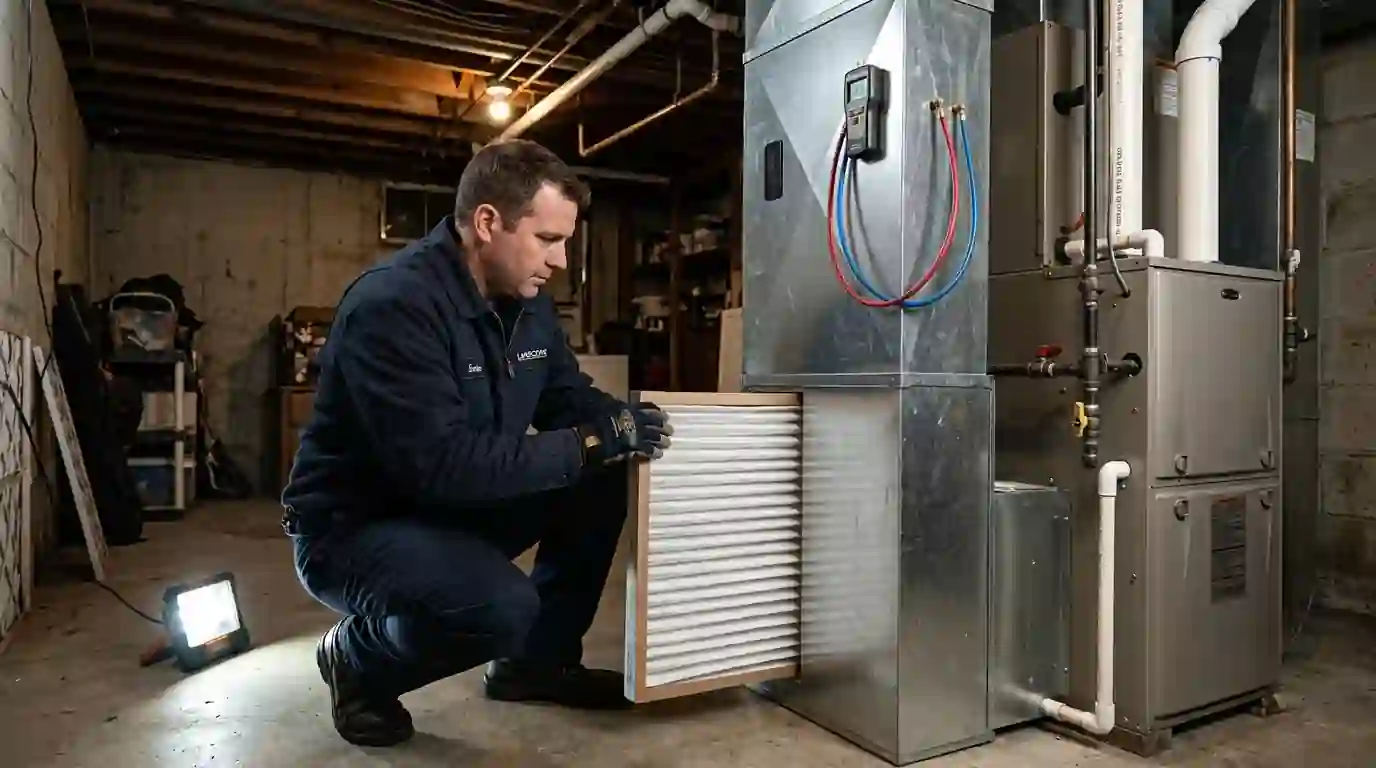
Whole-home air purification usually means a deeper media filter cabinet rated MERV 11 to 13, sometimes paired with a UV light on the coil. We match the filter to what your blower can push so airflow is not choked. A media cabinet runs $385 to $795 installed and a UV light $485 to $1,195.
Your furnace blower moves the entire volume of air in your house through the filter several times an hour. That makes the filter slot the most effective place to catch dust, pollen, pet dander and smoke particles, as long as the filter is good enough to trap them and the blower can still move air through it. The thin 1-inch filter most homes came with is mainly there to protect the equipment, not your lungs.
Better filtration is not as simple as buying the highest number at the hardware store. A dense 1-inch MERV 13 filter can raise static pressure enough to cut airflow, freeze an AC coil or overheat a furnace. Landcons measures static pressure before and after so the upgrade helps your air without hurting your equipment. We also tell you plainly what each add-on can and cannot do, because some products promise more than physics allows.
Comparing whole-home air cleaning options
Each technology targets a different problem, so the right choice depends on what you want to remove.
| Option | Best for | Keep in mind |
|---|---|---|
| 4 or 5-inch media filter, MERV 11 to 13 | Dust, pollen, dander and most smoke particles | Low pressure drop when sized right and needs changing once or twice a year |
| UV-C coil light | Keeping the evaporator coil and drain pan clean | Does little to clean moving air and the bulb needs yearly replacement |
| Electronic air cleaner | Fine particles with low airflow resistance | Cells must be washed every few months and some models produce ozone |
| Portable HEPA purifier | One bedroom or a single problem room | Treats only that room and adds noise and filter costs |
When a filtration upgrade is worth it
Not every home needs more than a good filter changed on time. These situations are where an upgrade pays off.
Someone in the house has allergies or asthma
Pollen, pet dander and dust mite debris are mostly in the 1 to 10 micron range, which MERV 11 to 13 media catches well. It won't cure allergies, but it lowers how much the household breathes.
Pets that shed through the year
Dogs and cats keep dander and hair circulating constantly. A deep media filter holds far more of it before loading up than a 1-inch pleat does.
Dust returns within days of cleaning
Fast dust buildup usually points to a weak filter, a leaky return duct pulling from the basement, or both. We check the ducts as well as the filter.
Wildfire smoke or nearby construction
Fine smoke particles are under 2.5 microns. MERV 13 media captures a large share of them when the blower runs, which helps on hazy summer days.
A 1-inch filter rack that bends and leaks
Many filter slots have gaps around the edges, so air bypasses the filter entirely. A sealed media cabinet closes that leak.
How we choose and install the right air cleaner
We start with your blower and duct system, then pick equipment that fits them.
Measure total external static pressure
We drill test ports and read static pressure with a manometer. Most residential blowers are rated for 0.5 inches of water column, and many homes already run near or above that.
Check the return duct size
Undersized returns are common, and adding filter resistance to a starved return makes things worse. Sometimes the fix is a second return before any filter upgrade.
Select the filter and cabinet
A 4 or 5-inch media cabinet spreads the air over far more pleated surface, so a MERV 11 to 13 filter adds little pressure drop. We size the cabinet to the blower's airflow in CFM.
Install with sealed connections
The cabinet goes between the return drop and the furnace, with mastic or foil tape on every joint. A good seal means air goes through the media, not around it.
Add UV only where it helps, then retest
A UV-C lamp aimed at the wet evaporator coil and drain pan keeps biological growth off them, though it does little to clean air moving past at speed. We finish by reading static pressure again and writing the filter size and change interval on the cabinet.
What Allen County air throws at your filter
Northeast Indiana sits in corn and soybean country, and spring and fall bring heavy pollen, harvest dust and ragweed that ride into the house every time a door opens. Furnaces run hard here from October through April, so the filter sees months of continuous airflow. A 1-inch filter that is fine for three months in a mild climate can be loaded with debris in six weeks during a cold Fort Wayne January, especially with pets or a wood stove.
Older homes add their own sources. A converted gravity system in Lakeside or North Anthony may have return grilles at floor level in the basement that pull dust and moisture straight from the stone or block walls. Newer, tighter houses in Huntertown and Aboite hold indoor pollutants longer because less outdoor air leaks in. Both kinds of houses benefit from better media filtration, though the tight house may also need fresh air from a ventilator rather than just a better filter.
What filtration and UV upgrades cost
Here are typical installed ranges, plus the ongoing filter cost you should plan for.
| Item | Typical range |
|---|---|
| Media filter cabinet with MERV 11 to 13 filter | $385 to $795 |
| UV-C coil and drain pan lamp | $485 to $1,195 |
| Added return duct to relieve static pressure | $385 to $795 |
| Replacement 4 or 5-inch media filter | $45 to $119 |
| Replacement UV bulb | $85 to $189 |
| Airflow and static pressure check | $89 to $149 |
What moves the price
- Space between the furnace and the return drop decides whether a standard cabinet fits.
- Homes with undersized returns may need duct work before any filter upgrade.
- Filter brand and MERV rating change the replacement cost each year.
- UV lamps need a power source near the coil and a safe mounting location away from plastics.
- Electronic air cleaners cost more upfront and need regular cell washing.
These are typical ranges. The real price depends on your blower, duct layout and what we find during the airflow check. See every range in one place in our HVAC price guide.
Keep your air cleaner working after we leave
Filters only work if they are changed and fit properly.
- Change 4 or 5-inch media every 6 to 12 months, sooner with pets.
- Check the filter monthly during the first winter to learn your home's pace.
- Install the filter with the airflow arrow pointing toward the furnace.
- Keep the cabinet door latched and its gasket intact.
- Replace UV bulbs yearly even if they still glow.
- Never look directly at a lit UV-C lamp.
Brands we work on
We service Carrier, Trane, Lennox, Goodman, Rheem and every other major make, plus WaterFurnace geothermal units built here in Fort Wayne.
Areas we cover for this service
We run this work across Fort Wayne and the towns around it. These are the places we are called to most; if your town is not listed, call and ask.
Air Purification & Filtration questions we hear often
Is a MERV 13 filter too restrictive for my furnace?
In a 1-inch slot it often is. The same MERV 13 rating in a 4 or 5-inch media cabinet has many times the surface area, so pressure drop stays low. We measure your static pressure before recommending any rating. If the blower is already near its limit, we fix the return duct first rather than forcing a denser filter into the system.
Do UV lights for HVAC systems kill viruses in the air?
Only a little. Air passes a coil-mounted UV lamp in a fraction of a second, which is not enough exposure to treat most airborne germs. Where UV does help is on surfaces that stay in its light, like the wet coil and drain pan, which keeps mold and slime from growing there. We recommend it for that purpose, not as an air sterilizer.
Will whole-home air purification stop my allergies?
It can lower the amount of pollen, dander and dust you breathe indoors, and many people notice fewer symptoms. It won't cure allergies, and it can't catch allergens that settle into carpet and bedding before reaching a return. Pairing better filtration with regular vacuuming, washing bedding and controlling humidity gives the best results.
How often should I change a 4-inch air purification filter?
Most homes in this area change a 4-inch media filter every 6 months, with some going to 12. Pets, renovation dust, a wood stove or a long heating season shorten that interval. A quick monthly look is the best guide: if the pleats are gray and packed, replace it no matter how long it has been in.
Are ozone-producing air purifiers safe to add to my HVAC system?
We don't install products that generate meaningful ozone. Ozone is a lung irritant, and the EPA has cautioned against using ozone generators in occupied homes. If you're considering an electronic or ionizing cleaner, look for one that meets the California Air Resources Board ozone limit, and ask us to explain how it would fit your system.