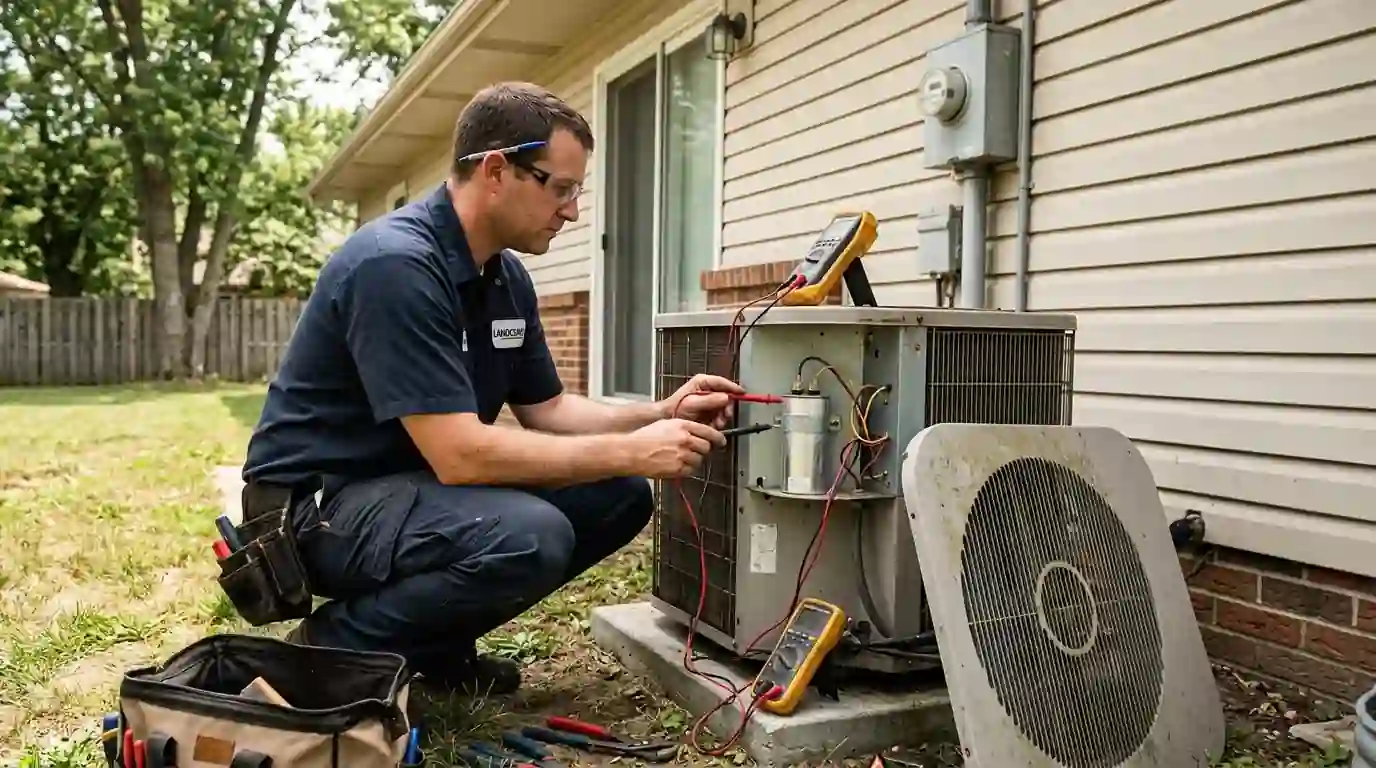
AC repair starts with finding which part failed: most no-cool calls trace to a weak run capacitor, a pitted contactor, a failed condenser fan motor, a clogged condensate drain or a dirty coil. A diagnostic runs $89 to $149, and common part repairs range from $165 to $845. Most repairs are finished the same visit because we carry the common parts.
A central air system is a small set of parts that all have to work at once. The thermostat calls, the contactor in the outdoor unit closes, the capacitor gives the compressor and fan motor their starting kick, refrigerant moves heat from the indoor coil to the outdoor coil, and the blower pushes air across it all. When any one of those pieces fails, you get warm air, no air, ice on the lines or water on the basement floor.
Our technician works through the system in that order with meters and gauges instead of guessing. We test capacitor microfarads against the rating on the label, check voltage across the contactor, measure amp draw on the compressor and fan, read suction and liquid pressures, and check temperature split at the return and supply. Then you get a plain explanation of what failed, what it costs, and whether the rest of the system looks healthy enough to keep.
AC problems that mean it is time to call for a repair
Some of these are minor and some are early warnings of a bigger failure. All of them are worth a look before a hot week arrives.
Outdoor unit hums but the fan does not spin
This is the classic sign of a failed run capacitor or a seized condenser fan motor. Shut the system off at the thermostat, because a compressor straining without its fan can overheat quickly.
Air from the vents is cool but not cold
A healthy system usually drops air 16 to 22°F between the return and the supply. A smaller split points to low refrigerant, a dirty coil, or a compressor that is not pumping well.
Ice on the copper lines or indoor coil
Frost on the large suction line means the coil is running too cold, usually from a clogged filter, a weak blower or low charge. Turn the system to fan only and let it thaw before we arrive.
Water around the furnace in the basement
The condensate drain or pump has clogged or failed. Left alone, it can soak finished flooring and trip a float switch that shuts the AC off.
Breaker trips when the AC starts
A shorted compressor, a failing capacitor or a loose wire can pull too much current. Do not keep resetting it, because repeated resets can damage the compressor windings.
Short, frequent cycles
If the system turns on and off every few minutes, the cause might be an oversized unit, a thermostat in a bad spot, or a pressure or high-limit safety tripping. Short cycling also leaves the house humid.
Clicking, buzzing or grinding outside
Chattering contactors, buzzing from a weak capacitor and grinding from worn fan bearings each have a different fix. Listening for a minute before you shut it off helps us narrow it down.
What our technician checks on an AC repair visit
We follow the same diagnostic path every time, so the answer you get is based on readings rather than a hunch.
Thermostat, filter and breakers
We confirm the thermostat is calling, the filter is not choking the blower, and both the indoor and outdoor disconnects are on. A surprising number of no-cool calls end here.
Electrical test at the condenser
With power safely isolated, we test the capacitor against its microfarad rating, inspect the contactor points for pitting, and check wiring for burns or rodent damage. Then we power it back up and measure amp draw on the compressor and fan motor.
Refrigerant pressures and temperatures
We connect gauges and calculate superheat and subcooling to see whether the charge is right and whether the metering device is feeding the coil properly. Low charge means a leak, so we note it rather than just topping it off.
Airflow, coil and drain
We check blower speed, static pressure where needed, the indoor coil face for dirt or ice, and the condensate trap, line and pump. Restricted airflow causes more frozen coils than refrigerant problems do.
Repair, then verify
Once we replace the part, we run the system long enough to read stable pressures and a normal temperature split. You get the readings, the part replaced and any other concerns written on the invoice.
Typical AC repair prices in the Fort Wayne area
Most AC repairs land in a predictable range once we know which part failed.
| Item | Typical range |
|---|---|
| Diagnostic visit (daytime) | $89 to $149 |
| Run or dual capacitor replacement | $165 to $395 |
| Contactor replacement | $175 to $385 |
| Condenser fan motor | $395 to $845 |
| Condensate pump replacement and drain clearing | $185 to $435 |
| Refrigerant leak search | $245 to $495 |
What moves the price
- Which part failed and whether it is a universal part or brand specific.
- Whether the system uses R-410A, older R-22 or newer R-454B, since refrigerant work varies a lot in cost.
- Access to the indoor coil and drain in finished basements or tight closets.
- Night, weekend and holiday visits, which carry a higher service call.
- Whether one failure caused a second, such as a bad capacitor that overheated a fan motor.
These are typical ranges, not quotes. Our technician gives you the exact price after the diagnosis and before any work starts. See every range in one place in our HVAC price guide.
What Fort Wayne summers do to air conditioners
July afternoons around Fort Wayne average about 84°F, but the humidity is what makes an AC work hard. Systems here spend a big part of every run pulling water out of the air, which means condensate drains, pumps and coil pans see heavy use. Many of our summer calls in the basements of post-war ranches on the north and east sides are simply a clogged drain line or a dead condensate pump that tripped the safety switch and shut the AC off.
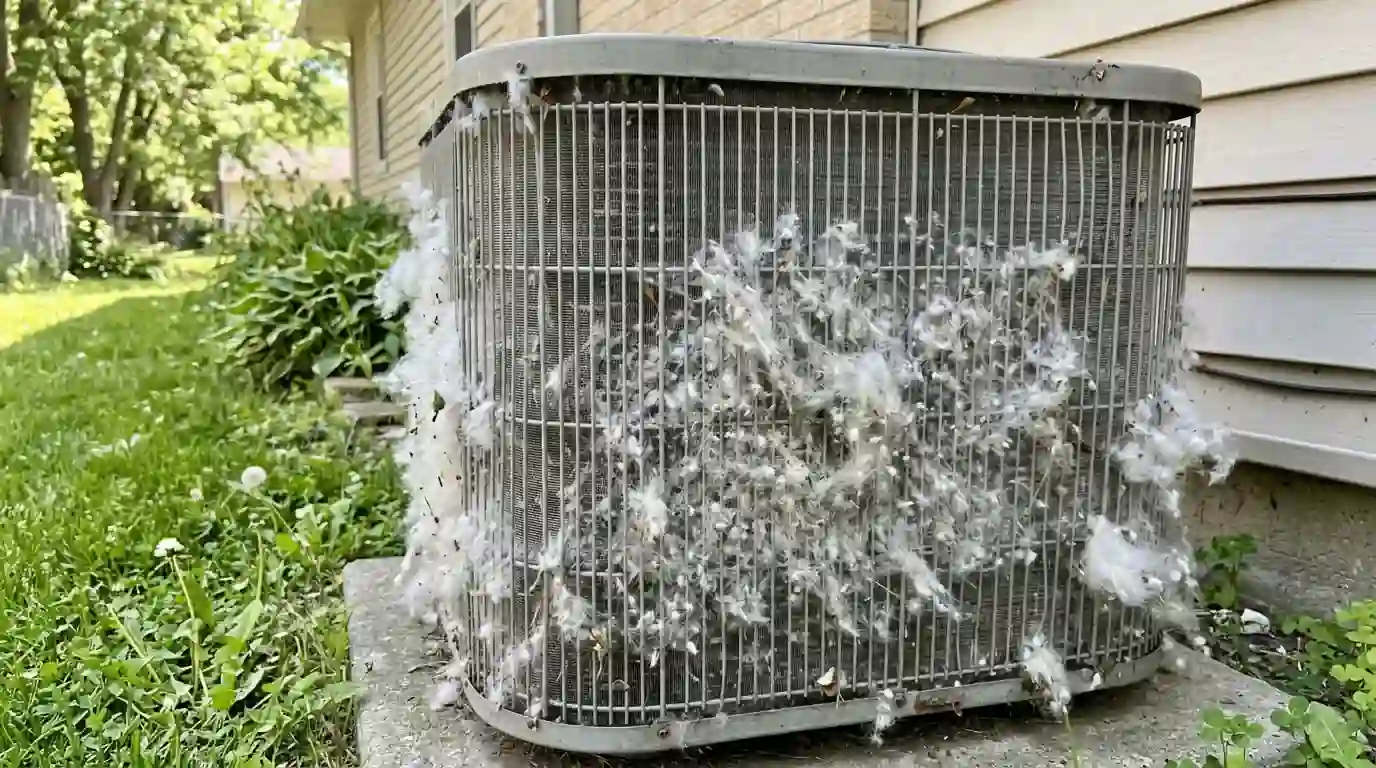
Early summer brings its own trouble. Cottonwood seed drifts across yards near the St. Joseph and St. Marys rivers in late May and June and mats onto outdoor condenser coils like felt. A coil blanketed in cottonwood cannot shed heat, head pressure climbs, and the capacitor and compressor take the strain on the first hot afternoon. If your unit sits near trees along the river corridors, a quick look at the coil fins in June can head off a mid-July breakdown.
Quick checks before you call about your AC
These take five minutes and sometimes solve the problem outright.
- Set the thermostat to cool and a few degrees below room temperature, and replace weak batteries.
- Check the filter and replace it if it is gray or bowed.
- Make sure both breakers and the outdoor disconnect are on.
- Look for water in the drain pan or around the furnace.
- Shut the system off if you see ice on the lines and run the fan only to thaw it.
- Rinse cottonwood and grass clippings off the outdoor coil gently with a garden hose.
Brands we work on
We service Carrier, Trane, Lennox, Goodman, Rheem and every other major make, plus WaterFurnace geothermal units built here in Fort Wayne.
Areas we cover for this service
We run this work across Fort Wayne and the towns around it. These are the places we are called to most; if your town is not listed, call and ask.
AC Repair questions we hear often
Why does my AC repair keep coming back to the capacitor?
Capacitors weaken with heat and age, and a unit that runs hot because of a dirty coil or a struggling fan motor wears them out faster. If yours keeps failing, we check head pressure, fan motor amp draw and the coil condition. Replacing the capacitor without fixing the reason it overheats just resets the clock.
Is it worth doing an AC repair on a 15 year old system?
Often yes, if the repair is a capacitor, contactor, fan motor or drain issue and the compressor is healthy. If the compressor is failing or the system has a major R-22 leak, replacement usually makes more sense. We give you the repair price and an honest read on the rest of the system so you can decide.
Can I run my air conditioner while waiting for an AC repair?
It depends on the symptom. If the outdoor fan is not spinning, the breaker trips, or the lines are iced, shut it off to protect the compressor. If it is simply running weak, you can usually keep it on, but avoid setting the thermostat very low, which makes it run nonstop.
How long does a typical AC repair take in Fort Wayne?
Most electrical repairs like a capacitor or contactor take under an hour once diagnosed. A fan motor takes one to two hours. Leak repairs and coil work can take longer or need a second visit if a part has to be ordered. We tell you up front which kind of repair you are looking at.
Do you handle AC repair on all brands?
Yes. We work on Carrier, Trane, Lennox, Goodman, Rheem, Ruud, American Standard, Bryant, York, Amana, Daikin and others. Most capacitors, contactors and many fan motors are universal parts, so brand rarely slows a repair down. Brand specific control boards or coils may need to be ordered.