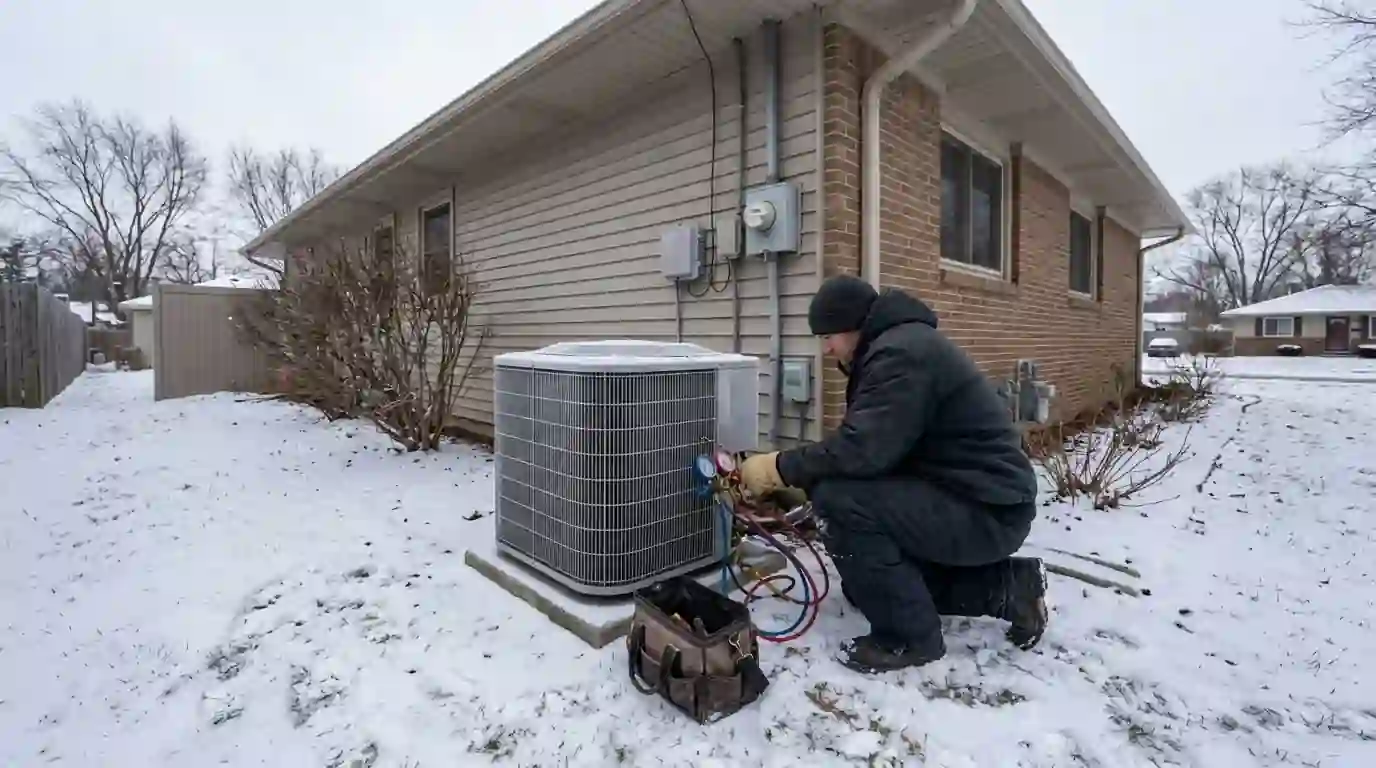
Heat pump repair means diagnosing why the system is not moving heat: failed defrost controls, a stuck reversing valve, low refrigerant charge, a weak compressor or a faulty auxiliary heat circuit. Common repairs range from $165 to $695, while a reversing valve runs $1,185 to $2,495. We test refrigerant pressures, coil temperatures and defrost operation before recommending anything.
A heat pump is an air conditioner that runs backward in winter. A reversing valve redirects the refrigerant so the outdoor coil absorbs heat from cold air and the indoor coil releases it into the house. Because the outdoor coil gets colder than the air around it, frost builds up, and the system periodically flips into a short defrost cycle to melt it. Most winter heat pump problems trace back to one of those pieces: the reversing valve, the defrost board and its sensors, or the refrigerant charge that makes the whole thing work.
Diagnosis is different from a furnace call. Our technician checks suction and discharge pressures, superheat and subcooling, coil temperatures and compressor amperage, then forces a defrost cycle to watch it initiate and terminate. We also check the auxiliary heat strips in the air handler, because a heat pump that seems fine but runs up huge bills is often running on resistance heat all day. Whether it is a ducted system, a cold-climate model or one paired with a gas furnace, we find which part of the cycle is failing.
Heat pump problems we see most often in winter
Some frost and steam are normal on a heat pump. These are the symptoms that are not.
The outdoor coil stays packed with ice
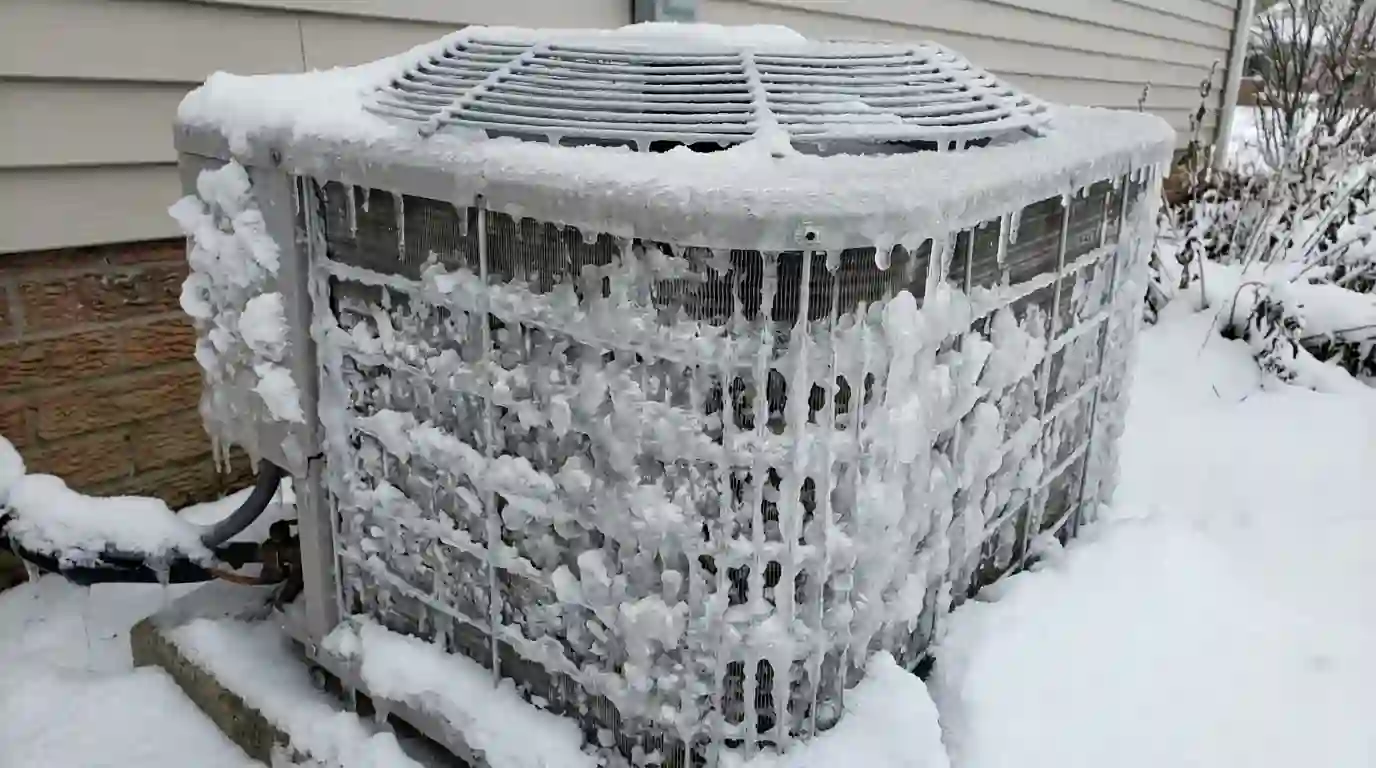
Light frost that clears every 30 to 90 minutes is normal. A solid block of ice that never melts points to a failed defrost board, a bad coil sensor, low refrigerant or a stuck reversing valve.
Lukewarm air in heating mode
Heat pump supply air feels cooler than furnace air, usually 90°F to 105°F, but it should still feel warm on your hand. Air near room temperature means the compressor, refrigerant charge or reversing valve needs testing.
"Aux heat" or "Emergency heat" on all day
Backup heat strips should help on the coldest days and during defrost. If the thermostat shows auxiliary heat running constantly in 35°F weather, the heat pump is not carrying its share and your electric bill will show it.
Blowing cold in winter, cold in summer reversed
If the system cools when set to heat, or heats when set to cool, the reversing valve solenoid or the thermostat O/B wiring is the usual suspect.
Loud whoosh, buzz or rattling outdoors
A whoosh during defrost changeover is normal. Continuous buzzing, grinding or a fan that will not spin while the compressor hums means an electrical or motor failure.
Water pouring or ice on the ground below
Defrost water should drain away from the unit. When it refreezes into a mound under the coil, the unit can ice itself in, especially if it sits too close to the ground.
How we diagnose a heat pump that is not heating right
Heat pumps need testing in both modes. We work through the system in this order.
Thermostat setup and wiring
We confirm the thermostat is configured for a heat pump, with the correct O/B setting and auxiliary heat staging. Wrong settings cause a surprising number of winter complaints.
Refrigerant pressures and temperatures
Gauges and temperature clamps give us superheat and subcooling in heating mode. Low charge points to a leak, which must be found and repaired under EPA Section 608 rules before recharging.
Force and watch a defrost cycle
We jumper the defrost board to start a cycle, confirm the reversing valve shifts, the outdoor fan stops, and aux heat comes on indoors. Then we check that the cycle ends at the right coil temperature.
Compressor, capacitor and contactor
We measure compressor amps against the rating plate, test the run capacitor in microfarads and inspect contactor points. Weak capacitors are a cheap fix that prevents a costly compressor failure.
Auxiliary heat strips and sequencers
Indoors, we check each electric heat element and its relay or sequencer. One burned-out element can leave the house cold during defrost and on the coldest nights.
Airflow and drainage
We check the filter, indoor coil and blower speed, then make sure the outdoor unit sits high enough for defrost water to drain clear of the coil.
Typical heat pump repair costs
Most heat pump repairs fall in the lower rows. Reversing valve and compressor work are the expensive exceptions.
| Item | Typical range |
|---|---|
| Diagnostic visit, weekday | $89 to $149 |
| Run capacitor | $165 to $395 |
| Defrost control board | $345 to $695 |
| Refrigerant leak search | $245 to $495 |
| Reversing valve replacement | $1,185 to $2,495 |
What moves the price
- Refrigerant type matters: R-410A is priced per pound at $89 to $159, and R-22 systems face much higher refrigerant costs and are usually not worth recharging.
- Reversing valve and compressor repairs require recovering the refrigerant, brazing, a nitrogen pressure test and an evacuation before recharging.
- Cold-climate and variable-speed inverter heat pumps use proprietary boards and sensors that cost more than standard parts.
- Parts still under the manufacturer's coverage reduce the parts cost, though labor is charged.
- Outdoor work in snow, ice or freezing rain may need to wait for safe conditions.
These are typical ranges for the area. The technician gives you a firm price after diagnosis, before any repair begins. See every range in one place in our HVAC price guide.
Heat pumps in northeast Indiana winters: what fails and why
Heat pumps work hard here. Older models lose capacity quickly below about 30°F, and January nights around 17°F push them deep into defrost cycles and auxiliary heat. Newer cold-climate units hold capacity much lower, but they still need correct charge and working defrost controls. Freezing rain is a particular local problem: a coating of ice on the outdoor coil and fan guard can overwhelm the defrost cycle and lock the fan blades. After an ice storm, check that the fan blades can turn and switch the thermostat to emergency heat if the coil is encased, then call us.
Placement matters too. Many outdoor units around Allen County sit on a pad just a few inches off the ground, where 30 inches of seasonal snow, roof runoff and drifting leaves can bury the coil. We often recommend raising the unit on a stand or moving a downspout that dumps water onto it. In rural parts of the region, heat pumps are frequently paired with a propane furnace, and with Indiana Michigan Power supplying the electricity, the balance point between the two fuels makes a real difference to winter bills.
Heat pump checks to do yourself before calling
These are safe and quick, and they rule out the simplest causes.
- Confirm the thermostat is set to Heat, not Emergency Heat, unless the outdoor unit is iced solid.
- Check both breakers: one for the outdoor unit, one for the air handler and heat strips.
- Replace a dirty filter, which can cause both icing and weak airflow.
- Clear snow and leaves at least two feet around the outdoor unit.
- Never chip ice off the coil with a tool; the fins and tubing damage easily.
- Make sure gutters and downspouts are not dripping onto the top of the unit.
- Note how long the unit runs between defrost cycles and whether steam appears.
Brands we work on
We service Carrier, Trane, Lennox, Goodman, Rheem and every other major make, plus WaterFurnace geothermal units built here in Fort Wayne.
Areas we cover for this service
We run this work across Fort Wayne and the towns around it. These are the places we are called to most; if your town is not listed, call and ask.
Heat Pump Repair questions we hear often
Does a steaming outdoor unit in winter mean I need heat pump repair?
Yes. During a defrost cycle the outdoor coil heats up to melt frost, and the meltwater often rises as visible steam for a minute or two. The fan stops during that time and you may hear a whoosh when the reversing valve shifts. Steam is normal. Ice that never clears is the sign that heat pump repair is needed.
Why is my electric bill so high even though the heat pump seems to work?
The most common reason is that auxiliary electric heat strips are running far more than they should. A stuck defrost, low refrigerant, a miswired thermostat or an outdoor temperature sensor fault can all keep resistance heat on. Heat pump repair that fixes the root cause often cuts a winter electric bill noticeably.
Can I run emergency heat while waiting for heat pump repair?
Yes, emergency heat runs the backup heat strips or furnace without the outdoor unit. It keeps the house warm while you wait for heat pump repair, especially if the outdoor coil is iced solid. It costs more to run on electric strips, so use it as a bridge for a day or two, not for weeks.
How long does a heat pump reversing valve repair take?
Usually four to six hours. The refrigerant must be recovered, the old valve cut out and a new one brazed in under a nitrogen purge, then the system is pressure tested, evacuated with a vacuum pump and recharged by weight. If the valve needs ordering for your model, it is typically a two-visit job.
Is heat pump repair worth it on an R-22 system?
Small electrical repairs like a capacitor or contactor often are. Anything that requires adding refrigerant usually is not, because R-22 production ended in 2020 and remaining supply is expensive. On an older R-22 heat pump with a leak or a failing compressor, we price the repair against a replacement so you can compare.