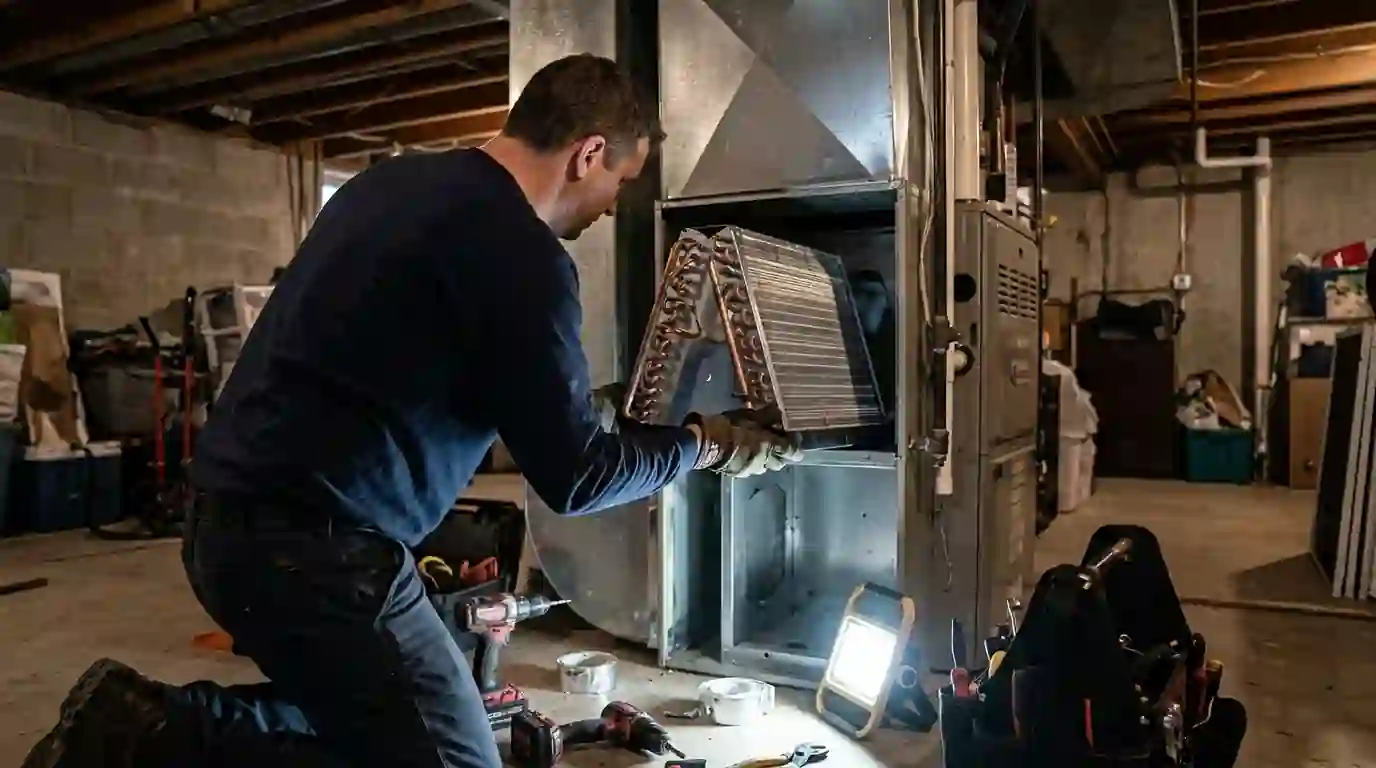
Evaporator coil replacement means recovering the refrigerant, removing the leaking or damaged A-coil above your furnace, installing a coil matched to the condenser's tonnage and refrigerant, then pressure testing, evacuating and recharging. It typically runs $1,485 to $2,995 installed. The work usually takes four to seven hours once the coil is on hand.
The evaporator coil is the indoor half of your air conditioner. It usually sits in a sheet metal cabinet right on top of the furnace in the basement, shaped like an A, with refrigerant boiling inside its copper or aluminum tubes to absorb heat from the air the blower pushes across it. Because it is always cold and wet in summer, it is also where formicary corrosion, pinhole leaks and clogged drain pans tend to show up as a system ages.
Replacing a coil is not just swapping a part. The new coil has to match the outdoor unit's capacity and refrigerant, use the right metering device (a TXV or a piston sized for the system), fit the furnace cabinet width, and leave room for the drain and the filter. Landcons checks each of those before ordering, then confirms with superheat and subcooling readings after startup that the new coil and the old condenser are actually working as a pair.
Coil replacement compared with the alternatives
Here is how replacing the coil stacks up against the other ways to handle a leaking indoor coil.
| Option | Best for | Keep in mind |
|---|---|---|
| Replace the evaporator coil only | Healthy R-410A condenser under about ten years old | Must be a matched coil; the condenser keeps its current age |
| Replace coil and condenser together | Systems past 12 to 15 years or still using R-22 | Higher cost, but everything is new, matched and on current refrigerant |
| Keep recharging the leaking coil | Only as a short bridge before a planned replacement | Costs more every year and stresses the compressor |
When the indoor coil, not the whole AC, needs replacing
Coil replacement makes sense when the problem is clearly in the coil and the rest of the system still has life left.
A leak search pins the leak to the coil
When electronic detectors or a nitrogen isolation test show the indoor coil losing pressure while the line set and condenser hold, the coil is the problem. Tube leaks inside the coil are rarely repairable for long.
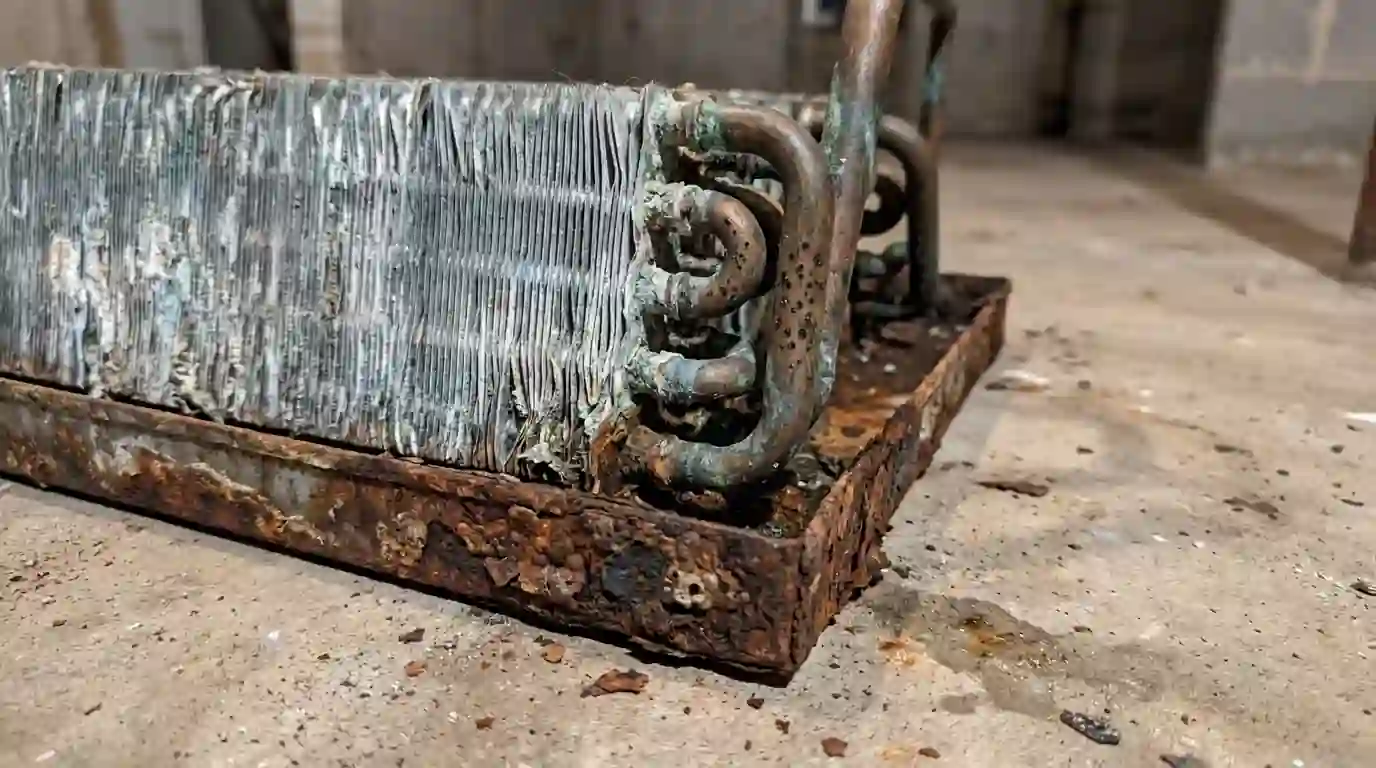
Green or black pitting on the copper tubes
Formicary corrosion leaves tiny pinholes and dark discoloration across the tubes, often near the bends. Once it starts, new leaks keep appearing across the coil.
The drain pan has rusted through
Older coils with steel drain pans can rust and drip water onto the furnace below, damaging its controls and heat exchanger. If the pan is not replaceable on its own, the coil goes with it.
The condenser is relatively new
If your outdoor unit is under about ten years old and healthy, replacing just the coil restores the system for far less than a full replacement.
The coil is packed with dirt that will not clean
Coils that went years without a filter can be matted so deeply that cleaning cannot restore airflow without damaging fins. Replacement is sometimes the only real fix.
Manufacturer's parts warranty covers the coil
Many systems carry a parts warranty that includes the coil. In that case the part may be covered and you pay labor, refrigerant and related materials.
How we replace an evaporator coil above your furnace
The order of the work is what protects the new coil and the existing compressor.
Match the coil before ordering
We record the condenser model, tonnage, refrigerant and the furnace cabinet width, then select a coil from the condenser manufacturer's matched combinations. We note whether it needs a TXV or piston and whether the furnace is upflow or horizontal.
Recover refrigerant and open the plenum
Refrigerant is recovered into a tank under EPA Section 608 rules. Then we cut the lines, open the supply plenum or coil cabinet and remove the old coil and its drain pan.
Set the new coil and seal the cabinet
The new coil is leveled with a slight pitch toward the primary drain, the cabinet is sealed with mastic and foil tape so air does not bypass the coil, and the plenum is reattached square to the furnace.
Braze, test and evacuate
We braze the line connections with nitrogen flowing, protect the TXV with a wet rag or heat paste, pressure test, and pull a deep vacuum that has to hold before refrigerant is released.
Charge, drain test and startup readings
We charge by weight and fine-tune by subcooling or superheat, then pour water into the pan to confirm the trap and drain carry it away. Final readings and the temperature split go on your invoice.
Why indoor coils fail in Fort Wayne basements
In most local homes the coil sits on a furnace in the basement, and that location shapes how coils age here. Long humid summers mean the coil runs wet for months, and many basements in older neighborhoods near the rivers stay damp on their own. That moisture, combined with household chemicals stored nearby such as cleaners, paint and laundry products, can speed up formicary corrosion in copper tubes. A coil that lasted 20 years in one house might start leaking at 9 in another.
Fort Wayne's mix of equipment ages also matters. Many 1970s to 1990s homes in Pine Valley, Georgetown and Covington have a furnace that was replaced once but an AC coil that was never touched, or a condenser that was replaced while the old coil stayed. A mismatched coil and condenser can run with the wrong metering device and never deliver the rated capacity. When we replace a coil here, we also check whether the furnace blower can move enough air across it.
Evaporator coil replacement cost, broken down
The coil, labor, refrigerant and any related parts make up the total.
| Item | Typical range |
|---|---|
| Evaporator coil replacement installed | $1,485 to $2,995 |
| R-410A refrigerant (per pound) | $89 to $159 |
| Labor only, when the coil is under parts warranty | $845 to $1,495 |
| Plenum modification for a different coil height | $185 to $485 |
What moves the price
- Coil size, metering device and whether it is cased or uncased.
- Whether a manufacturer's parts warranty covers the coil itself.
- Refrigerant type and how many pounds the system needs.
- Plenum, duct or drain changes needed for the new coil to fit.
- Whether replacing the condenser at the same time makes more sense on an older system.
- Access in finished basements or tight furnace closets.
These are typical ranges. We confirm the matched coil and give you the exact installed price before ordering anything. See every range in one place in our HVAC price guide.
Coil replacement or full system: what to weigh
These points help decide between a coil alone and a complete replacement.
- Age of the outdoor condenser and whether its compressor tests healthy.
- Refrigerant type, since an R-22 system with a leaking coil usually points to full replacement.
- Whether the coil is covered by a parts warranty.
- Age and condition of the furnace the coil sits on.
- Past repair history on the system.
- How long you plan to stay in the home.
- Whether the system has kept the house comfortable apart from the leak.
- Any plans to add a heat pump or change equipment soon.
Brands we work on
We service Carrier, Trane, Lennox, Goodman, Rheem and every other major make, plus WaterFurnace geothermal units built here in Fort Wayne.
Areas we cover for this service
We run this work across Fort Wayne and the towns around it. These are the places we are called to most; if your town is not listed, call and ask.
Evaporator Coil Replacement questions we hear often
How do I know my evaporator coil needs replacement and not just a repair?
If a leak search finds the leak inside the coil tubes, or corrosion pitting is visible across the coil, replacement is the reliable fix. Leaks at an accessible joint or the TXV connection may be repairable. We show you where the leak is and explain why we recommend repair or replacement.
Can I put a new evaporator coil with my R-22 outdoor unit?
It can be done with a coil rated for R-22, but it is rarely worth it. You still need R-22 refrigerant, which is no longer produced, and the condenser is likely near the end of its life. In most cases a complete system on current refrigerant is the better value.
Does evaporator coil replacement include a new drain pan?
Yes. Most replacement coils come with their own drain pan, usually a corrosion-resistant composite. We reconnect the primary drain with a proper trap, add a secondary drain or float switch where needed, and test it with water before closing up.
Will a new evaporator coil make my AC cool better?
If the old coil was leaking, mismatched or clogged, yes. A matched coil with the correct metering device and a full charge restores the system's rated capacity and dehumidification. If airflow from the furnace blower is weak or ducts are undersized, we address that too, since a new coil cannot fix low airflow by itself.
How long does evaporator coil replacement take once the part arrives?
Most coil swaps take four to seven hours on site. Brazing, pressure testing and pulling a proper vacuum take time that should not be rushed. If the plenum needs modification for a taller coil or the furnace is in a tight closet, plan on a full day.