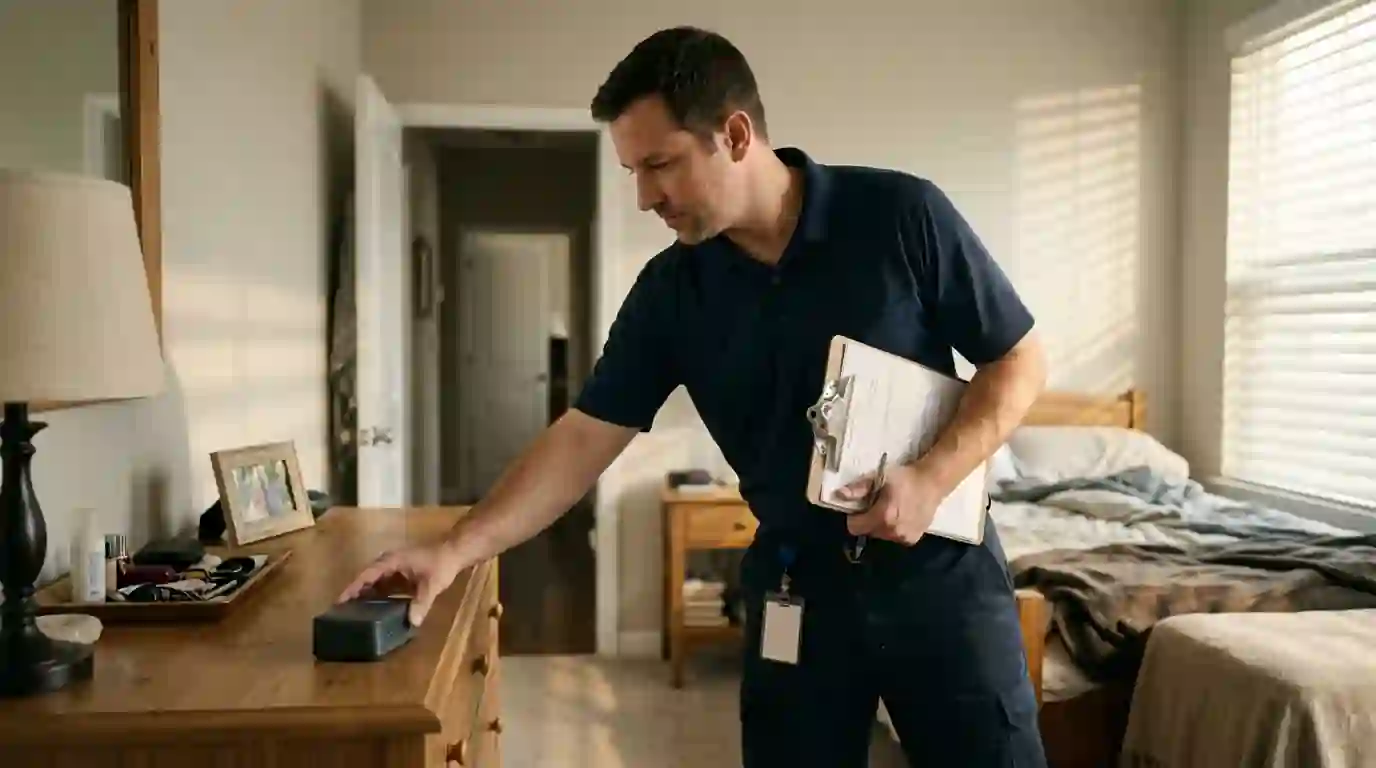
Indoor air quality testing is a visit where we measure humidity, dew point, carbon dioxide, fine particles, total VOCs and HVAC airflow in several rooms, then explain what is causing the problem. It typically costs $189 to $395 and takes two to three hours. You leave with readings and a prioritized list of fixes.
Air quality complaints have many possible causes, and the fix for one can make another worse. A humidifier helps a dry house and hurts a damp one. A denser filter helps with dust and can starve the blower. A ventilator helps a stuffy tight home and does nothing for a leaky duct pulling basement air. Testing first means you spend money on the problem you actually have.
During the visit, our technician sets up data-logging meters, walks every floor and runs the HVAC system while measuring what it delivers. We look at numbers, not impressions. Landcons doesn't sell lab mold sampling or radon mitigation, and we'll tell you when a result points to a specialist instead of HVAC equipment. What we do well is connect the readings to the furnace, ducts, filtration, humidity and ventilation that shape the air you breathe every day.
Before your air quality test
A few simple steps make the readings more accurate.
- Keep the house closed up as you normally would for 12 hours before the visit.
- Don't run candles, air fresheners or cleaning sprays that morning.
- Leave the current filter in place so we can see how it's loading.
- Write down when symptoms are worst and in which rooms.
- Clear a path to the furnace, return ducts and attic hatch.
- Have any past radon or mold test results handy.
- Note any recent remodeling, new flooring or new furniture.
Reasons homeowners ask us to test their air
Most calls start with a symptom or a worry. These are the common ones, and testing helps sort them out.
Stuffiness and afternoon headaches
High carbon dioxide from too little fresh air is a common culprit in tight homes. A CO2 reading over a few hours tells us whether ventilation is the issue.
Musty odor in parts of the house
Odor usually tracks humidity above 60 percent somewhere, often a basement or closet on an outside wall. We map humidity and surface temperatures room by room.
Dust that settles faster than you can clean
Particle counts at supply registers, compared with room air, show whether the ducts are pulling dirty air from somewhere they shouldn't.
A new baby, elderly parent or asthma diagnosis
Many families want a baseline before making changes. Real numbers help you and your doctor talk about what's in the home.
New paint, flooring or furniture smell
Total VOC readings rise sharply after renovations and new cabinets. We show how fast levels drop with more ventilation. Most of those compounds fade over weeks, faster with fresh air coming in.
Rooms that are too hot, cold or drafty
Comfort problems are air quality problems too, since poor airflow often means poor filtration and humidity control in that room.
What happens during an indoor air quality visit
We gather data in a set order so each reading builds on the last one.
Talk through the symptoms
We ask when the problem is worst, which rooms are affected, and what changed recently. That shapes where we place meters.
Log humidity, dew point and CO2
Data loggers go in a bedroom, the main living area and the basement for the length of the visit. Relative humidity, dew point and CO2 trends tell us about moisture and ventilation.
Count particles and VOCs
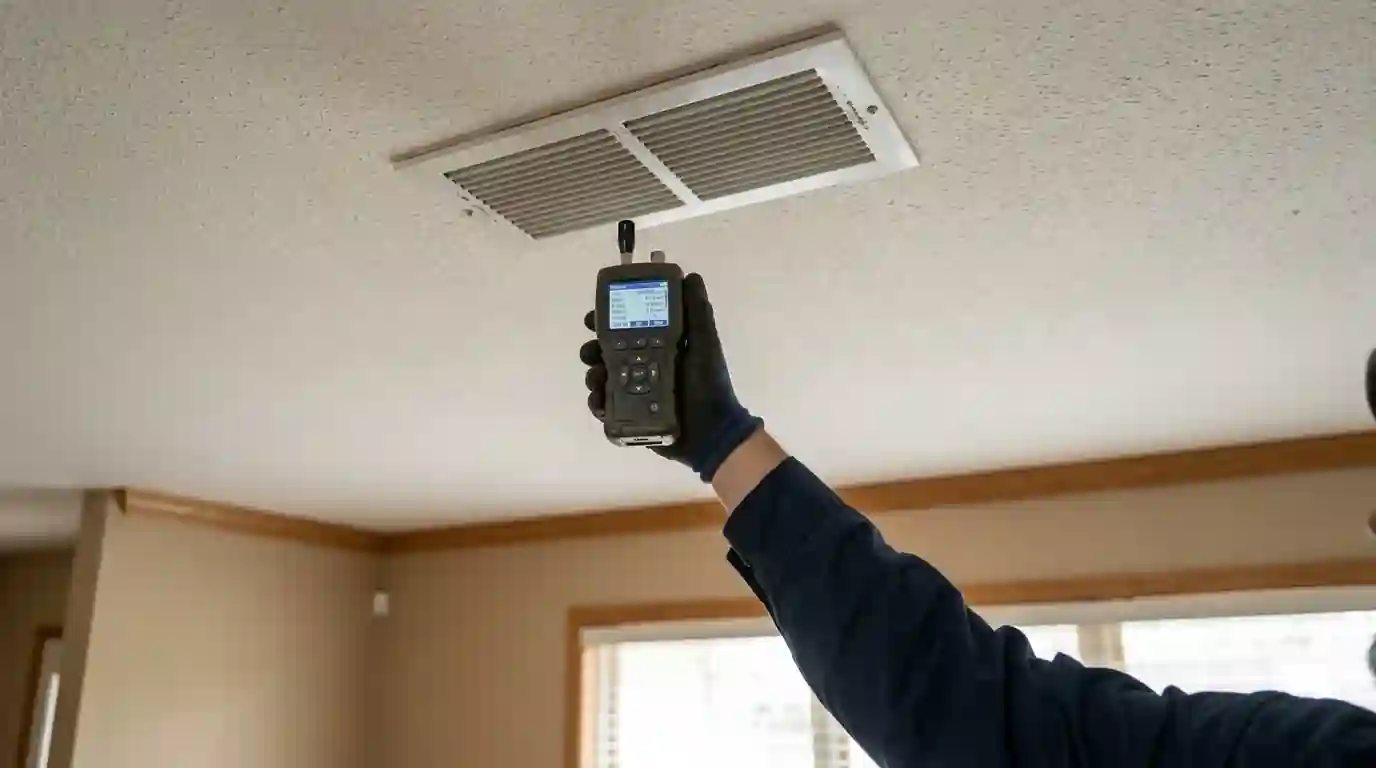
A laser particle counter reads PM2.5 and PM10 in rooms and at supply registers. A handheld meter takes total VOC readings near new materials and in the main living space.
Measure HVAC airflow and static pressure
We read total external static pressure and estimate blower airflow in CFM. Low airflow can explain poor filtration, coil icing and uneven rooms. A blower straining against a clogged filter or undersized return moves less air through every room, and that shows up in the other readings too.
Check the filter, coil and duct leakage
We look at filter fit, the evaporator coil and drain pan, and use smoke to find leaks at return ducts in the basement or attic. A return leak in a damp basement or dusty attic means the system is spreading that air through the whole house.
Review results at the kitchen table
We sit down with you, go over every number, and rank the fixes from least to most expensive. You decide what, if anything, to do next.
What an air quality test costs
The price depends mainly on house size and how many rooms we monitor. Repairs or equipment we recommend afterward are priced separately.
| Item | Typical range |
|---|---|
| Indoor air quality testing visit, typical home | $189 to $395 |
| Extended CO2 and humidity logging, 7 days | $145 to $265 |
| Combustion and CO check added to the visit | $89 to $169 |
| Duct leakage smoke test of the basement or attic | $119 to $235 |
What moves the price
- Larger homes with more floors take longer and need more meter placements.
- Extended logging catches overnight and weekend patterns a short visit can miss.
- Testing gas appliances at the same visit costs less than a separate trip.
- Lab mold or asbestos sampling is outside our scope and would be a separate specialist cost.
- Radon testing is done with its own kit or monitor and is not part of the HVAC visit.
These are typical ranges for this area. The actual price is set by the size of your home and the tests you choose. See every range in one place in our HVAC price guide.
Air quality patterns we see across Fort Wayne
The city's housing tells two different air quality stories. Pre-1940 homes in West Central, Southwood Park and Wildwood Park leak air through every window sash and attic floor, so they rarely have CO2 problems but often run very dry in January, with readings in the teens when nights fall toward 17°F. Many also have basement returns pulling damp air from stone or block walls, which shows up as musty smells and high particle counts at the registers. Fixing the return duct often does more than any purifier.
Newer homes in Aboite, Huntertown and the north-side subdivisions are the opposite. They hold heat well but can trap moisture, cooking fumes and CO2, especially with a full house on a winter weekend. We also remind every homeowner that Allen County is in EPA radon zone 1. Radon is a separate gas that needs its own test, ideally a long-term kit or a professional continuous monitor, and a high result calls for a radon mitigation system, not an HVAC upgrade.
Brands we work on
We service Carrier, Trane, Lennox, Goodman, Rheem and every other major make, plus WaterFurnace geothermal units built here in Fort Wayne.
Areas we cover for this service
We run this work across Fort Wayne and the towns around it. These are the places we are called to most; if your town is not listed, call and ask.
Indoor Air Quality Testing questions we hear often
Does indoor air quality testing include mold testing?
We measure the conditions that let mold grow, like humidity above 60 percent, cold surfaces and condensation, and we look for visible growth around HVAC equipment. We don't take lab spore samples or identify species. If our readings or a visible problem suggest mold, we recommend an independent mold assessor and then fix the moisture source on the HVAC side.
Should I test for radon as part of indoor air quality testing?
Radon needs its own test. Allen County is in EPA radon zone 1, so every home should be tested with a long-term kit or a professional continuous monitor. If results are at or above 4 pCi/L, a radon mitigation system with a sub-slab fan is the fix. HVAC equipment like an ERV can dilute radon slightly but isn't a substitute.
What CO2 level in a house means it needs more fresh air?
Outdoor air runs around 420 ppm. Indoors, readings that stay under about 1,000 ppm usually mean decent ventilation. Bedrooms that climb to 1,500 or 2,000 ppm overnight point to too little fresh air, and many people notice stuffiness and grogginess at those levels. We log CO2 over hours so we see the peaks, not just a single snapshot.
How long do indoor air quality test results take?
Most of our readings are live, so we go over results at the end of the same visit. If you choose extended logging, we pick up the meters after about a week and review the trends with you then. You get the numbers in writing either way, along with which fixes we'd try first and their typical cost.
Is indoor air quality testing worth it before buying an air purifier?
Usually, yes. If the readings show high humidity, a dehumidifier will do more than a purifier. If they show high CO2, you need ventilation. If particle counts jump at the supply registers, a leaky return duct may be the source. Testing first keeps you from buying equipment that treats the wrong problem.