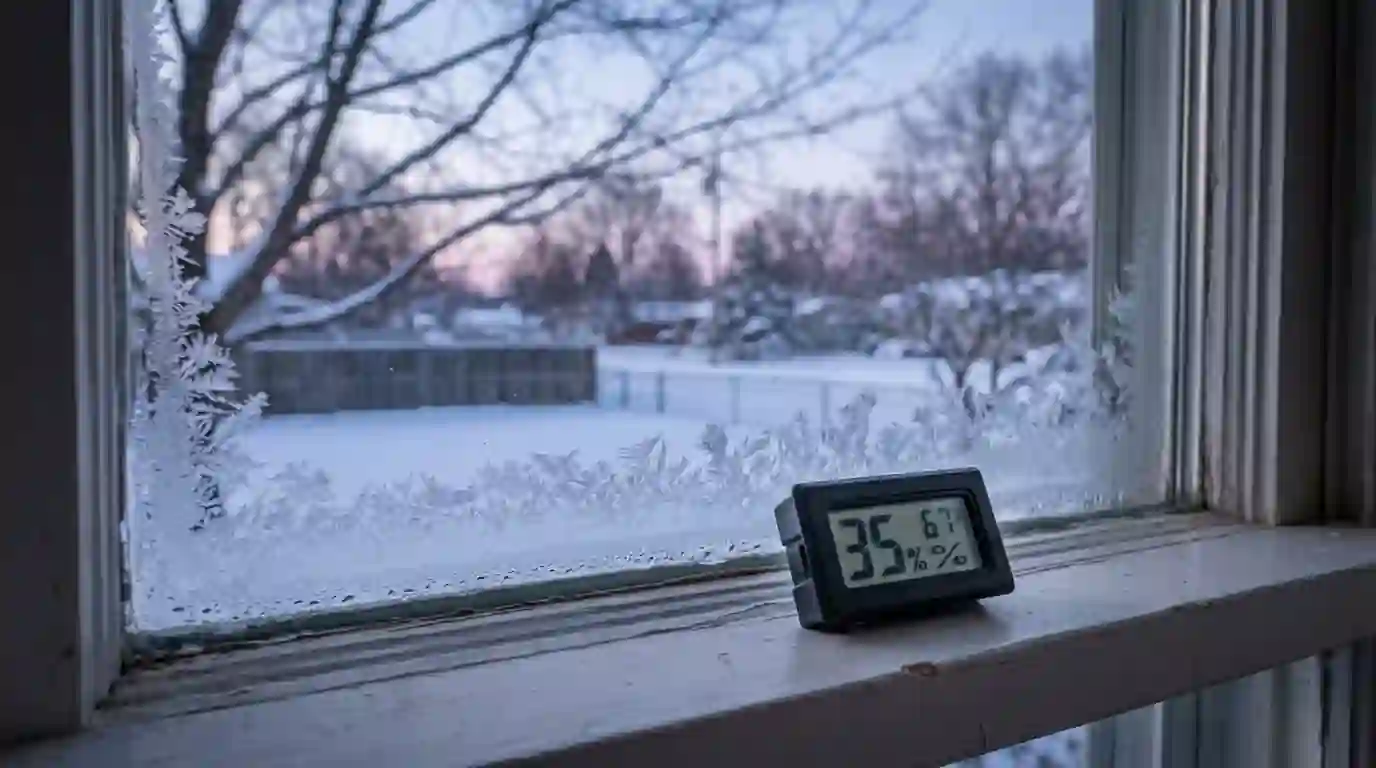
In winter, aim for about 30% to 40% indoor relative humidity and lower it as outdoor temperatures drop. Around 20°F outside, about 35% is a good target; near zero, about 30%; below zero, 25% or less. If water or frost forms on the inside of windows, the humidity is too high for that day's temperature, so turn it down.
Why winter air gets so dry inside
Cold outdoor air holds very little moisture. When that air leaks into your house and the furnace warms it to 70°F, its relative humidity drops sharply, often into the teens or low 20s on the coldest January days. The furnace itself does not dry the air; it just warms air that was already dry.
That is why the problem peaks in the same weeks as our coldest nights, when January lows average around 17°F. Older, leakier houses swap more indoor air for outdoor air, so they tend to run drier than tight newer homes. A house with a lot of air leakage can be hard to humidify at all until some of those leaks are sealed.
Signs your house is too dry, or too damp
Low humidity shows up in the body and around the house. High humidity shows up on cold surfaces first, especially windows and exterior wall corners. Keeping an eye on both tells you whether your setting is right for the week's weather.
- Too dry: static shocks, dry skin and lips, scratchy throat in the morning
- Too dry: gaps opening in hardwood floors, trim or furniture joints
- Too dry: indoor humidity readings below about 25% on a mild winter day
- Too damp: water or frost on the inside of window glass
- Too damp: dark spots or mold in closet corners on outside walls
- Too damp: musty smell in bedrooms or a basement that never dries
A simple outdoor temperature to indoor humidity target table
The colder it gets outside, the colder your window glass and outside wall surfaces get, and the less moisture the house can hold before it condenses. These targets are a widely used rule of thumb for a reasonably insulated home with double-pane windows. Older single-pane or drafty windows may need settings a few points lower.
- 40°F outside: up to about 40%
- 20°F outside: about 35%
- 10°F outside: about 30% to 35%
- 0°F outside: about 30%
- 10 below zero outside: about 25%
- 20 below zero outside: about 20%
How the right humidity changes comfort and heating bills
Moist air feels warmer than dry air at the same temperature, because your skin loses less heat to evaporation. Many people find that bringing the house from the low 20s up to the mid 30s lets them sit comfortably a degree or two lower on the thermostat. We will not promise a specific savings number, since it depends on the house and how you set things, but comfort at a lower setting is real.
Proper humidity also protects the house. Hardwood floors, wood trim, pianos, guitars and the plaster in older homes all move as humidity swings. Holding a steady, moderate level through the winter reduces the cracks and gaps that show up every February.
Measuring humidity you can trust
A basic digital hygrometer costs a few dollars and is worth having in a main living area, away from the kitchen, bathrooms and supply registers. Cheap meters can be off by several points, so compare two of them or check one against a smart thermostat that reads humidity. Watch the trend over a few days rather than reacting to one number.
Remember that cooking, showers, laundry and people all add moisture. A reading taken right after dinner will run higher than one in the middle of the afternoon. Your windows are also a reliable gauge: if they stay clear on a cold morning, you are probably not overdoing it.
Room humidifiers versus a whole-home humidifier
Portable humidifiers help one room, need daily refilling and cleaning, and can grow bacteria and leave white dust if they are not cleaned well. They are fine for a bedroom or a nursery. For a whole house, a humidifier mounted on the furnace and controlled by a humidistat is easier to live with.
A bypass humidifier uses furnace heat to evaporate water across a pad and runs a typical $585 to $1,195 installed. A steam humidifier makes its own steam, works even when the furnace is not running much, and runs a typical $1,385 to $2,495. These are typical ranges, and the real price depends on the visit, water line access and the furnace layout.
- Bypass: lower cost, uses furnace heat, pad needs changing each season
- Steam: more output and control, higher cost, needs a dedicated circuit
- Both: need a water line and a drain near the furnace
Setting and caring for a furnace humidifier
Many humidistats have a dial with outdoor temperature markings. If yours does not, use the table above and adjust it when the forecast changes. Some newer controls use an outdoor sensor and adjust automatically, which takes the guesswork out of window condensation.
Replace the water panel once a season, more often if your water is hard. Check that the damper on a bypass humidifier is open in winter and closed in summer. Before the heating season, look for drips, mineral buildup and a clear drain line; if the unit is leaking into the furnace, shut the water off and call us.
When humidity problems need a technician
Call us if windows keep sweating even at low settings, if a humidifier leaks or never seems to run, or if the house stays very dry no matter what you set. Those patterns can point to a stuck solenoid valve, wiring problems, an undersized unit, or air leakage that a humidifier cannot keep up with. Condensation that will not go away can also mean poor ventilation in a tight newer home, where an ERV or HRV may be the better fix.
Landcons installs and services humidifiers on all common furnace brands, and we answer 24/7. A service visit runs a typical $89 to $149 on weekdays. Call (260) 283-0173 and tell us what you see on the windows and the meter.
More questions on this topic
Why do my windows sweat when the winter humidity is only 35%?
On a very cold day, 35% can be too high for your windows. Glass is the coldest surface in the room, and older or single-pane windows reach the dew point quickly. Lower the humidistat a few points when temperatures drop near or below zero, keep blinds slightly open so warm air reaches the glass, and run bath fans after showers.
Is a whole-home humidifier worth it in an older Fort Wayne house?
It can be, but a leaky older house loses moisture almost as fast as you add it. We usually suggest sealing obvious attic and basement air leaks first, then adding a correctly sized humidifier. Historic homes with original windows may need lower settings to protect sashes and plaster from condensation, so we set expectations before installing anything.
Should a furnace humidifier be turned off in summer?
Yes. Shut off the water supply valve, close the bypass damper if you have one, and set the humidistat to off. Summer air in Allen County is already humid, and running a humidifier then adds moisture your air conditioner has to remove. Turn it back on in October with a fresh water panel.